


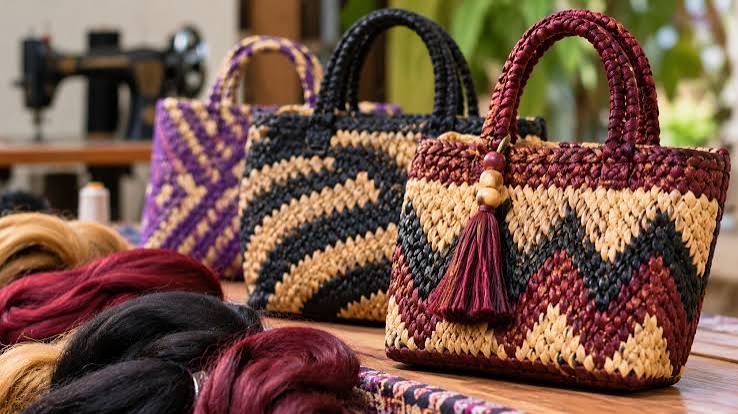
A group of Kenyan women is transforming discarded synthetic hair extensions into handmade bags, creating income opportunities while tackling plastic waste generated by the beauty industry.
The initiative, run by the social enterprise Queening Afrika, works with beauty salons to collect used synthetic hair that would otherwise end up in dumpsites or drainage channels.
Damaris Kuria, co-founder of Queening Afrika, said the organisation provides participating salons with collection bags. The discarded hair is then transported to its workshop, where workers sort it by colour and texture, wash reusable strands and prepare them for handcrafting.
The all-women team weaves the recovered material into fashionable bags and other products, giving waste commonly associated with braids and hairstyles a new purpose.
Beyond its environmental objectives, the initiative provides women with practical skills and a source of income. Experienced artisans also train and mentor younger workers, helping them develop weaving skills and make a living from their craft.
Veronica Musyoka, a mother of six who has worked with the enterprise for two years, said she uses her two decades of weaving experience to teach younger women. Her mentoring also addresses wider social challenges, including homelessness, early pregnancies and drug abuse.
Another participant, Rose Auma, said the work had helped her support her family and pay for her children’s education.
Joyce Gitau, a youth adviser working with Plan International Kenya, said about 10 young women were earning through Queening Afrika. She noted that the income helped participants meet everyday needs, including food, rent and school expenses.
The initiative comes against the backdrop of Kenya’s large informal economy. According to the Kenya National Bureau of Statistics’ Economic Survey 2026, the informal sector accounted for 87.2 per cent of the 822,100 new jobs created in the country in 2025.
Discarded synthetic hair presents a waste-management challenge because the material is plastic-based and does not readily decompose. When improperly disposed of, it can accumulate in dumpsites and obstruct drainage channels.
By linking waste collection with skills development and small-scale production, Queening Afrika is demonstrating how circular-economy initiatives can create livelihood opportunities while reducing pressure on the environment.
For the women involved, material often treated as rubbish has become a resource for entrepreneurship, financial support and community empowerment.





Leave a comment