


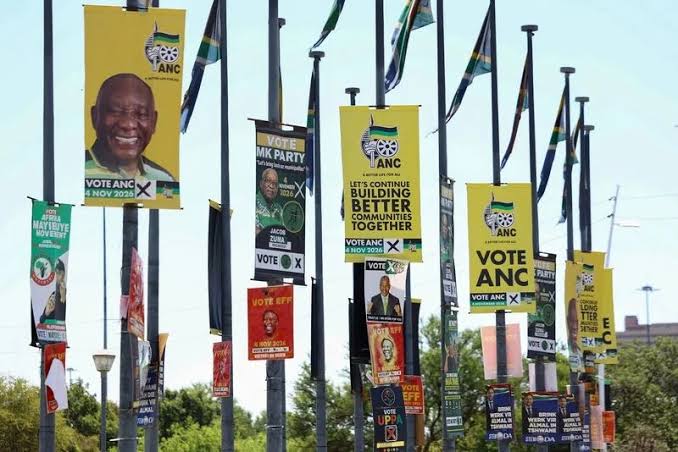
South Africa’s municipal elections are expected to deepen the country’s fragmented political landscape, with the governing African National Congress (ANC) facing mounting competition and parties preparing for complex coalition negotiations to control major cities.
Voters are scheduled to head to the polls on November 4, with the outcome expected to provide an important indication of the country’s political direction ahead of the 2029 national elections.
Although the ANC is projected to remain the largest political party nationally, opinion polls suggest its support could fall to between 31 and 34 per cent, roughly half the level it secured in the 2011 local elections.
The party’s declining support reflects growing voter frustration over persistent poverty, unemployment, poor public services and what many residents see as unfulfilled political promises.
The fragmentation is also benefiting parties beyond the main opposition Democratic Alliance (DA), with the left-leaning Economic Freedom Fighters (EFF) and former President Jacob Zuma’s uMkhonto weSizwe Party (MKP) attracting voters who have become disillusioned with the traditional political establishment.
Reuters reported that the shift is making outright majorities increasingly difficult to achieve, raising the likelihood that parties will have to negotiate partnerships to form municipal administrations.
Johannesburg is among the most closely watched battlegrounds. The country’s economic centre has experienced seven mayors since the 2021 municipal elections, as successive coalition arrangements collapsed.
The instability has contributed to concerns about deteriorating public services, infrastructure challenges and the city’s financial performance.
Helen Zille, the DA’s mayoral candidate, has campaigned on improving infrastructure and service delivery. The party is seeking to expand its support, while the ANC is attempting to retain its influence in the city.
Political analysts say a possible partnership between the ANC and DA could offer a route to a more stable administration, similar to their cooperation in the national government formed after the ANC lost its parliamentary majority in 2024.
However, both parties have expressed reservations about local coalition arrangements.
The ANC’s Johannesburg regional chairperson, Loyiso Masuku, said coalition partners could make it difficult for parties to implement their programmes. Zille also argued that coalition partners often failed to honour agreements.
Yunus Chamda, coordinator of the Joburg Crisis Alliance, said the current coalition system allowed smaller parties to exercise disproportionate influence while weakening accountability.
The outcome in Tshwane, which includes Pretoria, will also test the influence of smaller parties in South Africa’s fragmented political system.
ActionSA has emerged as an important player in the municipality after the DA lost control in 2024 following a no-confidence motion against its mayor, supported by the party.
In eThekwini, which includes Durban, Zuma’s MKP is expected to challenge the ANC’s traditional dominance in KwaZulu-Natal. The party’s growing support could significantly alter the balance of power in the metropolitan municipality.
Ekurhuleni, another major Gauteng municipality, is also expected to test the ANC’s declining support, with the DA emerging as a strong competitor.
Cape Town remains a stronghold of the DA, which has governed the city since 2006 and maintained an outright majority since 2011. The party is widely expected to retain control, although concerns over housing costs and gang violence remain important campaign issues.
The ANC, meanwhile, will be seeking to defend its support in traditional strongholds such as Buffalo City in the Eastern Cape and Mangaung in the Free State.
Beyond party competition, service delivery has emerged as a major issue shaping the campaign.
Residents are concerned about unemployment, deteriorating infrastructure, rising living costs and the reliability of municipal services. The ability of incoming administrations to address these challenges is expected to influence public confidence in local government.
The elections will therefore test not only the ANC’s ability to retain political influence but also whether opposition parties can translate growing voter support into stable and effective municipal administrations.
With hundreds of parties contesting the elections, coalition negotiations are likely to shape the next phase of local governance in many municipalities.
The central challenge for political parties will be to build administrations capable of delivering services, rebuilding infrastructure and attracting investment, despite competing political interests and fragile alliances.









Leave a comment