


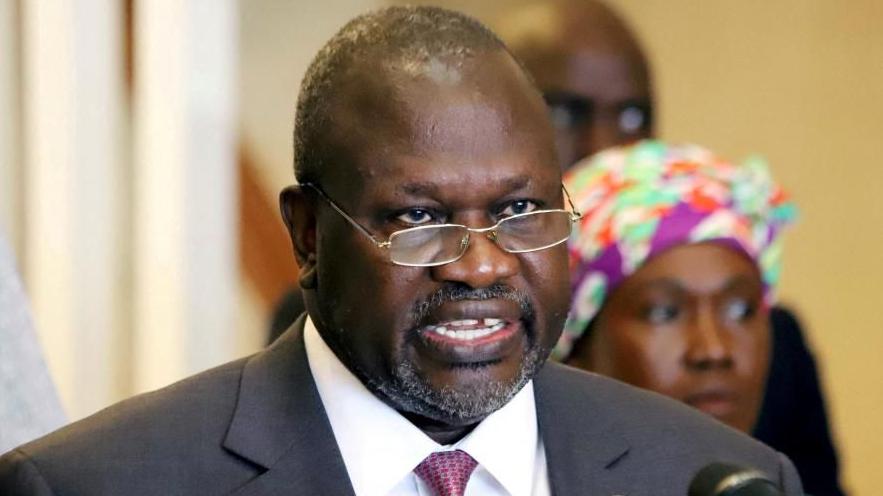
South Sudan has been thrust into deeper political turmoil after Justice Minister Joseph Geng announced on Thursday that First Vice President Riek Machar has been charged with murder, treason, and crimes against humanity. The charges stem from his alleged involvement in a series of attacks carried out in March by the White Army, an ethnic militia accused of targeting federal forces in the northeastern town of Nasir. The announcement was followed within hours by a presidential decree, broadcast on state radio, in which President Salva Kiir suspended Machar from his position as First Vice President, escalating tensions at the highest level of government.
Machar, a longtime rival of Kiir and leader of the Sudan People’s Liberation Movement/Army-in Opposition (SPLM/A-iO), has been under house arrest since March in connection with the Nasir attacks. The government alleges that evidence links him and other SPLM/A-iO leaders to directing or influencing the militia. In addition to Machar, Petroleum Minister Puot Kang Chol was also suspended and charged in connection with the violence. Justice Minister Geng confirmed that 20 individuals have been indicted, though 13 remain at large, while seven others will face trial alongside Machar.
The charges mark a dramatic escalation in the feud between South Sudan’s two main political blocs. Kiir and Machar, who fought on opposing sides during the devastating 2013–2018 civil war that killed an estimated 400,000 people, have struggled to maintain a fragile unity government formed under the terms of a peace deal. Though their uneasy partnership was meant to stabilize the world’s youngest country, sporadic violence and mutual distrust have continued to undermine progress.
International powers, including the United Nations, the African Union, and several Western governments, have repeatedly called for Machar’s release from house arrest, warning that his detention could destabilize the peace agreement and push South Sudan back toward civil war. Analysts say the timing of the charges risks inflaming ethnic divisions and emboldening armed groups, especially in a country where reconciliation remains incomplete and communities remain heavily militarized.
Justice Minister Geng defended the charges, saying the government had gathered sufficient evidence linking the White Army militia to SPLM/A-iO leadership. “Evidence further reveals that the White Army operated under the command and influence of certain leaders of the Sudan People’s Liberation Movement/Army-in Opposition (SPLM/A-iO), including Dr. Riek Machar Teny,” he told reporters. He added that while the government respects international concern, the case is now before the courts and therefore sub judice.
The decision has provoked sharp reactions at home. Civil society leaders expressed concerns that the trial could lack credibility and risk being perceived as politically motivated. Edmund Yakani, executive director of the Community Empowerment for Progress Organization, warned that justice must be served through a transparent and impartial process. “We hope the court trying Machar and the seven others will be a competent court of law, not a kangaroo court of law,” Yakani said in a statement.
Observers fear that Machar’s removal could shatter the already fragile balance of power within the transitional government. The charges come at a time when South Sudan is grappling with economic hardship, intercommunal violence, and preparations for long-delayed elections. With trust between Kiir and Machar at an all-time low, the latest developments risk reviving the bitter divisions that fueled years of conflict.
As the case unfolds, international attention will remain fixed on Juba, where the government’s handling of Machar’s trial and suspension could determine whether South Sudan can cling to its fragile peace or slide back into another devastating war. For many South Sudanese citizens, who have endured displacement, hunger, and decades of violence, the future once again hangs in the balance as the nation confronts a political crisis at its very core.






Leave a comment