


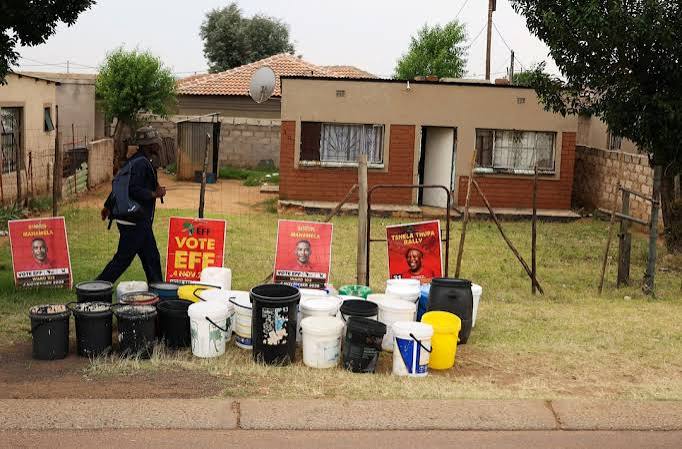
South Africa is heading into increasingly competitive municipal elections, with a fragmented electorate and declining support for the ruling African National Congress (ANC) setting the stage for multi-party contests and potentially difficult coalition negotiations across the country’s major cities.
The November 4 elections are expected to test the ANC’s remaining electoral strength as voters increasingly shift their support to opposition parties, including the Democratic Alliance (DA), the Economic Freedom Fighters (EFF) and former President Jacob Zuma’s uMkhonto weSizwe (MK) Party.
Although the ANC is expected to remain the largest single party nationally, opinion polls suggest its support could fall to between 31 and 34 per cent, a significant decline from the more than 60 per cent it secured in the 2011 local government elections.
The changing political landscape has made it increasingly difficult for individual parties to secure outright majorities in major municipalities, raising the likelihood that political parties will have to negotiate coalition agreements to form local governments.
For the ANC, the elections represent another test of its ability to retain control of urban centres following its loss of a parliamentary majority in the 2024 national elections.
The party’s declining support reflects growing voter dissatisfaction over persistent unemployment, poverty and concerns about service delivery.
Mpho Moroka, a 38-year-old unemployed resident of Soweto, told Reuters that she had switched her support from the ANC to the DA after nearly two decades of voting for the ruling party.
“I’m from the township. I saw the poverty, I saw the struggles and I saw that there is no change,” she said at a DA campaign rally.
The DA, South Africa’s second-largest political party, is seeking to benefit from the ANC’s declining popularity. However, analysts say the ruling party’s former supporters are not moving exclusively to the DA, with several opposition parties attracting votes from disillusioned citizens.
Louw Nel, a senior political analyst at Oxford Economics Africa, said the fragmentation of the electorate meant that support was spreading across multiple political organisations rather than consolidating behind a single opposition party.
The growing number of political parties contesting the elections further complicates the prospect of clear victories in several municipalities.
The likely need for coalition governments has raised concerns about political stability and the ability of municipal administrations to deliver essential services.
Johannesburg, one of the country’s most important economic centres, has experienced repeated changes in political leadership since the 2021 local elections. The city has had seven mayors since then, reflecting the instability of its coalition arrangements.
Yunus Chamda, coordinator of the civil society group Joburg Crisis Alliance, said shifting political alliances and negotiations between parties had contributed to instability in the city’s administration.
He argued that coalition arrangements had sometimes given smaller political parties disproportionate influence over municipal leadership, making it difficult to hold elected officials accountable for governance failures.
Johannesburg’s previous two mayors came from a party that held only three of the 270 seats in the city council, illustrating the influence smaller parties can exercise when larger political organisations depend on coalition support.
Chamda said the arrangement had created uncertainty in municipal governance and made it easier for political parties to deflect criticism by blaming coalition disagreements.
Political analysts have suggested that cooperation between the ANC and the DA could offer one possible route to more stable municipal administrations in Johannesburg, Tshwane and Ekurhuleni.
The two parties, which have historically been political rivals, joined forces in South Africa’s national government after the 2024 elections.
However, extending that partnership to municipal governments could prove difficult, given their competing political interests and differences over policy priorities.
Loyiso Masuku, the ANC’s Johannesburg regional chairperson, said coalition arrangements made it difficult for parties to implement their programmes fully.
The DA’s Johannesburg mayoral candidate, Helen Zille, also expressed reservations about coalition governance, arguing that political partners frequently failed to honour agreements reached during negotiations.
Both parties therefore face political considerations in deciding whether to work together at municipal level, even where cooperation could help secure a governing majority.
Beyond political alliances, unemployment, poverty and the demand for better public services remain central issues shaping voter decisions.
In Cape Town, 28-year-old first-time voter Abdul Tonta told Reuters that he wanted political change and greater employment opportunities.
He said repeated disappointments with political parties had influenced his decision to participate in the elections, adding that he wanted young people and members of his community to have better access to jobs.
The elections are taking place amid growing public concerns about municipal performance, infrastructure, water and electricity supply, crime and the cost of living.
The outcome is expected to shape the political leadership of South Africa’s major urban centres and provide an indication of how the country’s political landscape is evolving ahead of the 2029 national elections.
For the parties contesting the polls, the challenge will extend beyond winning votes to securing workable governing arrangements capable of providing stable leadership, improving municipal services, rebuilding infrastructure and attracting investment.








Leave a comment