


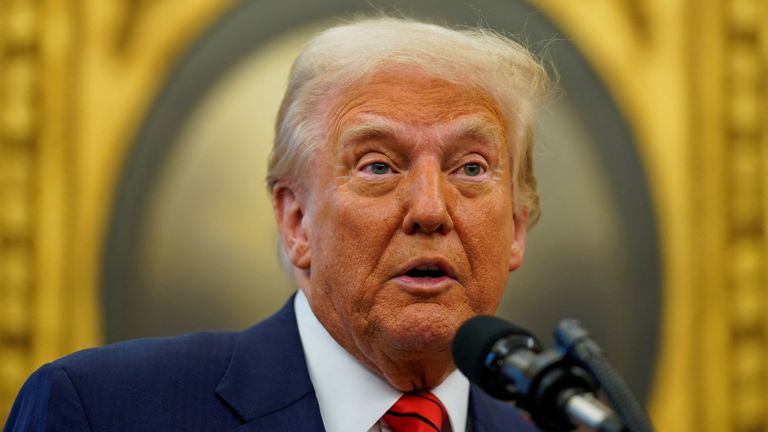
US President Donald Trump has launched a three-day summit in Washington D.C. with the heads of five African nations Gabon, Guinea-Bissau, Liberia, Mauritania, and Senegal in what the White House calls an “incredible” commercial opportunity focused on trade, security, and strategic partnerships. The summit, which marks a major diplomatic outreach during Trump’s second term, is being closely watched amid escalating concerns about the future of US-Africa relations, particularly around tariffs, migration, and access to Africa’s mineral wealth.
Trump’s “trade, not aid” agenda dominated the summit’s opening discussions. All five guest countries are currently facing 10% US tariffs on their exports a sharp blow to economies that rely heavily on duty-free access previously guaranteed under the African Growth and Opportunity Act (AGOA). With the act’s renewal uncertain, African leaders are lobbying for reduced trade barriers and renewed economic cooperation.
Mauritania’s President Mohamed Ould Ghazouani led the praise for Trump, citing the White House’s recent role in brokering peace between the Democratic Republic of Congo and Rwanda. Several African leaders called for Trump’s nomination for a Nobel Peace Prize, a move seen as both flattery and strategic diplomacy. Senegal’s President Bassirou Diomaye Faye went further, inviting Trump to build a golf course in Dakar and proposing a tech city on the Atlantic coast.
Beyond optics, the summit has become a forum for serious economic propositions. African leaders pitched their countries’ natural wealth especially rare earth minerals, oil, manganese, uranium, and gas, as major incentives for American investment. Gabon’s President Brice Clotaire Oligui Nguema issued a stark warning: “You are welcome to come and invest; otherwise, other countries might come instead of you,” referencing growing Chinese and Russian influence on the continent.
Gabon, which holds about 25% of the world’s known manganese reserves and supplies 22% of China’s demand, is seen as a particularly strategic player. Analysts believe the US is eyeing Gabon for both its resource wealth and its geographic location along the Gulf of Guinea a critical maritime route plagued by piracy and rich in offshore oil reserves. Talks of establishing a US military base in the region have surfaced, highlighting the intersection of security and economic interests.
For Mauritania and Senegal, illegal migration is also high on the agenda. Between 2023 and 2025, at least 20,000 young Mauritanians and hundreds of Senegalese migrants migrated to the US via Nicaragua, raising alarms in Trump’s administration. Immigration crackdowns and visa overstay concerns especially in Gabon and Liberia, are expected to play a role in any resulting bilateral agreements.
Meanwhile, Liberia is grappling with the fallout from massive US aid cuts that once made up nearly half of its healthcare budget. The country, which has deep historical ties with the US, may be considering an American proposal to accept deported individuals, including criminals in exchange for economic concessions. Liberia’s fragile health system, already battered by civil war and the Ebola crisis, is in desperate need of funds, prompting hopes for a new support framework.
Guinea-Bissau, once labeled a “narco-state” by the US, is seeking to rehabilitate its image. President Umaro Sissoco Embaló expressed pride in being invited to the White House and is reportedly pushing for the reopening of the US embassy in Bissau, which closed in 1998 after a military mutiny.
The summit is also taking place in the shadow of a recent diplomatic misstep involving South Africa. A May Oval Office meeting between Trump and President Cyril Ramaphosa did little to ease tensions. In a punitive follow-up, South Africa’s exports to the US will now face a 30% tariff, beginning next month.
With AGOA hanging in the balance and Trump doubling down on transactional diplomacy, the summit could set the tone for the future of US-Africa relations. African leaders are keen to avoid being sidelined and are leveraging their nations’ minerals, strategic locations, and migration controls as bargaining chips.
The outcomes of these negotiations could determine whether US-Africa trade thrives under Trump’s leadership or fractures under the weight of protectionism and geopolitical competition.






Leave a comment