


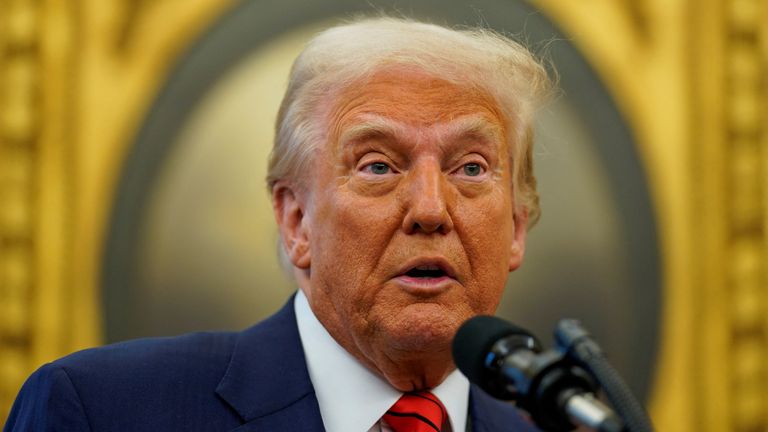
US President Donald Trump sparked a mix of amusement and criticism during a White House summit with five African leaders when he complimented Liberian President Joseph Boakai on his English-speaking skills, asking, “Where did you go to school? You speak such good English.” Boakai responded with a polite laugh but did not explain that English is the official language of Liberia, a nation with deep historical ties to the United States.
The comment, though seemingly light-hearted, has reignited conversations about cultural sensitivity and awareness in diplomatic settings. Liberia, founded in 1822 by freed African-American slaves, was established as a settlement for free Black people from the United States. As Africa’s oldest republic, English has been the country’s official language since its founding, and its political institutions, constitution, and educational system are modeled after the American system.
The moment occurred during a high-profile summit in Washington, D.C., where President Trump hosted leaders from Gabon, Guinea-Bissau, Liberia, Mauritania, and Senegal. The meetings are part of Trump’s broader “trade, not aid” strategy, aimed at securing new trade deals and access to Africa’s vast natural resources including rare earth minerals, oil, gas, and manganese amid growing Chinese and Russian influence on the continent.
While some observers dismissed the remark as a benign gaffe, critics have pointed out that it reflects a broader need for informed engagement with African nations, especially those like Liberia that share longstanding historical and linguistic ties with the US.
The summit continues to unfold as the leaders seek to negotiate favorable trade terms, discuss migration concerns, and respond to US policy shifts, including the reduction of aid and the uncertain future of the African Growth and Opportunity Act (AGOA), which currently grants duty-free access for certain African exports.
As global power dynamics shift and African leaders assert their role on the international stage, moments like these underscore the importance of mutual respect, historical awareness, and cultural understanding in diplomacy.











Leave a comment