


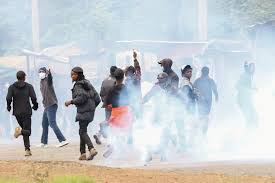
At least 11 people were killed and 567 arrested during the latest wave of anti-government protests in Kenya, which erupted nationwide on July 7th to mark the 35th anniversary of the historic Saba Saba movement. The demonstrations, led largely by Kenya’s Gen-Z population, called for government accountability, an end to police brutality, and deeper political reforms mirroring the spirit of the original 1990 protests that demanded multi-party democracy during the one-party rule of President Daniel arap Moi.
In a disturbing turn, police opened fire on protesters in several cities. Dr. Aron Sikuku, a medic at Eagle Nursing Home near Nairobi, confirmed that two people with gunshot wounds were brought to the facility, already deceased. Outside the hospital, crowds of emotional protesters demanded to take the bodies. The Kenya National Commission on Human Rights (KHRC) reported at least 10 deaths, 29 injuries, and 37 arrests, condemning police for what it described as excessive force and alleged collusion with armed criminal gangs across major towns, including Nairobi, Eldoret, Nakuru, Kiambu, and Kajiado.
The state-backed police service responded with a statement praising officers for their “restraint and professionalism” despite reports of plainclothes officers and the use of unmarked vehicles. They reported 52 officers and 11 civilians wounded.
Protests took place in at least 17 of Kenya’s 47 counties, with violent clashes erupting in Meru, Nairobi, Ol Kalou, and other towns. Fires were set in shopping centers, roads barricaded with razor wire, and access to government buildings like the State House and Parliament was restricted. A protester was shot dead in Ol Kalou, while another survived gunshot injuries. In Kamukunji, a symbolic protest site where the original Saba Saba protests began in 1990, demonstrators lit fires and attempted to breach police cordons.
Former Prime Minister Raila Odinga, a key figure in the 1990 protests and initially arrested during that time, had planned to attend Monday’s demonstrations but was blocked by police checkpoints. He condemned what he called a “rogue police force” inherited from colonial repression and called for a national dialogue to reform Kenya’s policing institutions.
Many long-distance travelers and commuters were stranded more than 10km from the city center. Major highways were blocked, leaving buses and their passengers stuck in areas like Kabete. “We want the government to engage in a dialogue with Gen-Zs so all this can come to an end,” bus driver Humphrey Gumbishi told the BBC.
On the eve of the protests, KHRC’s Nairobi headquarters was attacked by an armed gang of 25 men on motorbikes shouting anti-protest slogans. They destroyed property and stole laptops, phones, and valuables from journalists present during a women-led press briefing calling for an end to state violence.
The demonstrations are part of a broader wave of unrest that began last year in response to aggressive tax reforms and growing youth unemployment. On June 25th, another nationwide protest saw at least 19 people killed and widespread destruction of businesses.
With Kenya’s political future at a crossroads, the Saba Saba anniversary has reignited conversations about governance, youth inclusion, and state accountability. Gen-Z demonstrators, empowered by digital platforms and civil movements, are demanding a transformation that echoes the same cries for justice and democracy voiced in 1990—but in a new, more connected, and more urgent Kenya.









Leave a comment