


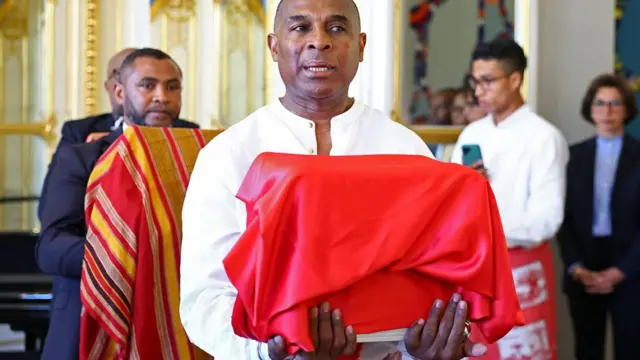
In a deeply symbolic moment that highlights the long and painful history of colonialism, the skull of King Toera, a 19th-century Malagasy monarch killed by French troops during the colonial conquest of Madagascar, has finally been returned to his homeland after nearly 130 years.
The solemn handover ceremony took place at the French Ministry of Culture in Paris, where French Culture Minister Rachida Dati described the return as an important act of justice. She acknowledged that the skulls of King Toera and two members of his royal court had entered France’s national collections under circumstances that were a violation of human dignity, reflecting the violence and injustice of colonial rule.
King Toera ruled over the Menabé kingdom of the Sakalava people in western Madagascar. In August 1897, French colonial troops sent to enforce control over the region carried out a brutal military campaign, massacring local fighters and killing King Toera. After his death, French soldiers decapitated him, and his skull was transported to Paris, where it was kept in the archives of the Museum of Natural History. His head, along with the remains of others, remained there for more than a century, a haunting symbol of the colonial violence inflicted upon Madagascar.
The decision to return the skulls was made possible by a recent law in France designed to accelerate the restitution of human remains taken during the colonial era. Until now, such cases were rare and required long bureaucratic processes. This law marks a turning point, allowing the return of cultural and ancestral remains with greater urgency and respect for the communities affected.
Although DNA tests conducted on King Toera’s skull were inconclusive, confirmation came through a traditional Sakalava spirit medium, who identified the remains as belonging to the monarch. For Madagascar, this spiritual validation carried profound cultural weight.
At the ceremony, Madagascar’s Culture Minister Volamiranty Donna Mara described the return as a “significant gesture,” noting that the absence of King Toera’s remains had left an “open wound in the heart of our island” for over a century. The restitution, she said, was not just a symbolic act but an important step in healing historical traumas and restoring dignity to the Malagasy people.
France has previously returned human remains acquired during the colonial period, the most notable being the remains of Sarah Baartman, a South African woman who had been cruelly exploited and displayed in Europe under the racist nickname “Hottentot Venus.” Her remains were repatriated in 2012 after decades of campaigning. However, the return of King Toera’s skull marks the first restitution carried out under France’s new legal framework, which is expected to open the door for many more returns in the future.
It is estimated that the Museum of Natural History in Paris alone holds over 20,000 human remains from across the globe. Many of these were collected during colonial expeditions and kept under the guise of scientific study. For countries that suffered under colonialism, the return of these remains is not only about correcting historical wrongs but also about reconnecting with lost heritage, ancestors, and spiritual traditions.
The return of King Toera’s skull represents a powerful acknowledgment of colonial injustice and a renewed effort to restore dignity to nations and peoples who endured centuries of oppression. For Madagascar, it marks the closing of a painful chapter and the beginning of a process of cultural and spiritual healing.












Leave a comment