


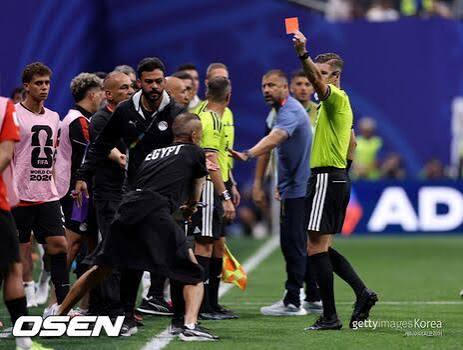
The Egyptian Football Association has broken its silence over what it believes was biased and unfair officiating during Egypt’s 3-2 round of 16 defeat against Argentina on Tuesday, one of the most dramatic collapses at this World Cup. The EFA declared it “cannot remain silent” and issued a formal statement vowing to defend the rights of the national team, while FIFA’s chief of refereeing pushed back sharply, insisting that the integrity of match officials cannot be questioned.
Egypt had appeared to be heading comfortably into the quarterfinals, leading 2-0 with just over ten minutes of normal time remaining. What followed was extraordinary. Argentina scored three unanswered goals in thirteen minutes to complete one of the biggest comebacks in World Cup history and send Egypt home. Coach Hossam Hassan and several players were left in disbelief, and their reaction after the final whistle set the tone for everything that followed.
The specific moment driving Egypt’s grievance centres on the 58th minute, when Marwan Attia appeared to have netted Egypt’s second goal. A VAR review overturned the effort, ruling that Attia had fouled Argentina defender Lisandro Martínez in the buildup to the goal. The EFA argues that the decision to disallow it was inconsistent and that the referee failed to use the VAR system appropriately across several key moments during the match. “Several key incidents raised serious concerns and left profound questions about the consistency and fairness of decisions that directly influenced the course of the game,” the EFA statement read.
FIFA’s response came swiftly and firmly. Pierluigi Collina, FIFA’s chief of refereeing, defended the Attia decision in direct terms. “If a foul is identified in the build-up and is deemed to have had an impact on the goal, the VAR will recommend an on-field review,” he said. “There is no defined limit regarding either the distance from goal or the amount of time between the incident and the goal.” On the specific incident in question, Collina was unambiguous: Attia “clearly treads on the foot of Argentina No. 6 Lisandro Martínez.” He added: “We believe that a foul is a foul. Regardless of whether the foul appears obvious, if the referee did not see it on the field of play, the VAR can intervene.”
Collina also addressed the broader allegations from Egypt with equal directness, warning that unfounded claims against officials carried real-world consequences. “Nobody can question the integrity of the FIFA World Cup match officials,” he said. “When this happens, it may provoke reactions that lead to threats against them and their families. This is not right.” He acknowledged that constructive discussion about decisions is a normal part of football but drew a clear line at what he described as unfounded allegations.
The match itself had unfolded in a way that gave Egypt every reason to believe they would advance. Mostafa Ziko scored to give them a 2-0 lead, and the game appeared to be under control. The turning point came in the 79th minute when Lionel Messi assisted Cristian Romero for Argentina’s first goal, triggering a momentum shift that Egypt could not reverse. The winning goal came two minutes into stoppage time. Coach Hassan’s response at the final whistle was striking. He held his arms in an X shape, a gesture he later said was in response to racial abuse directed at his team. After the match, he said Egypt had been victimised by a football establishment that favoured Messi and Argentina.
The dispute between Egypt and FIFA now plays out off the pitch, and the EFA has signalled it will not let the matter rest. Whether any formal complaint produces a different outcome is unlikely, given FIFA’s defence of its officials. But for Egyptian supporters who watched their team lead 2-0 and exit in the most painful circumstances imaginable, the sense of injustice will take time to fade, regardless of what the rulebook says about Attia’s foot.












Leave a comment