


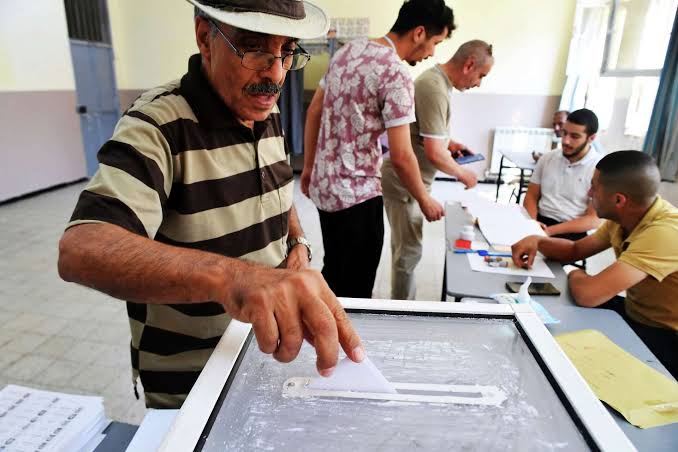
Algeria held legislative elections on Thursday to elect 407 members of its lower house of parliament, but the most telling result of the day was not which party won the most seats. It was how few Algerians chose to participate at all. Provisional turnout figures released by the National Independent Elections Authority stood at just 20 percent, a figure that, if confirmed, would represent a record low in Algerian electoral history, surpassing the previous low of 23 percent recorded in 2021.
About 25 million eligible voters were called to choose from 1,235 candidates standing across the country’s constituencies. By mid-afternoon, nationwide turnout had reached only 11 percent, with overseas voters registering just under 10 percent participation. Karim Khelfane, the interim head of the National Independent Elections Authority, acknowledged the provisional nature of the figures. “These figures are provisional. It is certain that they will change,” he said, though whether any final revision will significantly alter the picture of mass civic disengagement remains to be seen.
The ruling National Liberation Front, known by its French acronym FLN, was widely expected to retain its dominant position in the 407-seat National People’s Assembly, whose members serve five-year terms. The outcome of the vote in terms of seats was therefore never likely to surprise. What the election was always more likely to reveal was the depth of the gap between Algeria’s political establishment and the public it governs, and on that measure, Thursday’s results speak clearly.
The low turnout did not arise in a vacuum. The poll was held against a backdrop of controversy over the government’s disqualification of roughly a third of would-be candidates before the election even began. Some of those blocked said they had been prevented from competing in major constituencies, including the capital Algiers, raising questions about the openness of a process that was already being viewed with scepticism by large sections of the population. Rights groups have also pointed to shrinking civic freedoms and persistent cost-of-living concerns as factors driving voter apathy.
Those who did vote offered measured and cautious reasons for doing so. Djammel Bouakkaz, a 74-year-old retiree who spoke to AFP at a polling station in Algiers, summed up the mood with quiet resignation. “We came to fulfil our duty, hoping for something good. That’s all I have to say.” It is the language of a citizen who votes out of habit or obligation rather than genuine conviction that the ballot will change anything meaningful.
The electoral context stretches back to 2019, when the Hirak pro-democracy movement swept through Algeria and ultimately forced the resignation of long-serving president Abdelaziz Bouteflika after two months of sustained protests. The movement represented a moment of genuine popular energy and political possibility. That energy has since been systematically contained. President Abdelmajid Tebboune, elected later in 2019, won a second term in 2024, and the political landscape has continued to narrow rather than open in the years since Hirak’s peak.
The 2021 parliamentary elections, held in the aftermath of Hirak and its suppression, produced a then-record low turnout of 23 percent. That figure was already a damning verdict on public confidence in Algerian democratic institutions. If Thursday’s provisional 20 percent holds, it will represent a further deterioration, a message from Algeria’s electorate that whatever is on offer at the ballot box, they are not convinced it amounts to a meaningful choice. Interior Minister Said Sayoud declined to comment on the turnout figures, though he had earlier urged citizens to participate. The distance between that appeal and the reality of Thursday’s numbers tells its own story.






Leave a comment