


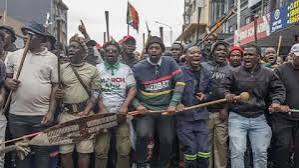
A fresh and sharply worded diplomatic dispute has broken out between Ghana and South Africa over the death of a Ghanaian national in Cape Town, with the two governments presenting contradictory accounts of how the man died, where he died, and whether the killing was connected to the wave of anti-immigrant protests that swept through South Africa this week.
Ghana’s foreign ministry stated on Wednesday that its national Bashiru Isak, 40, was shot and killed during anti-immigrant demonstrations linked to xenophobic attacks in Cape Town’s Khayelitsha township. Accra said it had formally registered its protest to Pretoria over the killing and described the death as directly connected to the hostile climate created by the ongoing anti-immigrant campaign in South Africa.
South Africa’s government rejected that account in blunt terms. Justice Minister Mmamoloko Kubayi said the Ghanaian government’s characterisation of the death was “factually incorrect” and “not based on fact,” adding that no fatalities had been recorded on the day of the protests. “It is concerning that Ghanaian authorities continue to communicate false information about South Africa regarding developments on irregular migration,” she said. “The spread of false information to perpetuate the false narrative that South Africa is xenophobic is unacceptable.”
South African police offered a different version of events entirely. Officers told AFP that a 35-year-old Ghanaian man, whose name differed from the one provided by the Ghanaian government, was shot at a barbershop on Monday, not Tuesday as Accra had claimed, and at a different location from the one cited in Ghana’s statement. According to police, unknown suspects entered the barbershop and demanded money from the victim before shooting him, leading investigators to believe the killing may have been extortion-related rather than connected to the protests. Foreign affairs spokesman Chrispin Phiri told SABC that South Africa expected its counterparts to consult through diplomatic channels before releasing information, noting that statements from Ghana had in recent times been “not only inaccurate but also not verifiable.”
Ghana’s foreign ministry, for its part, told AFP that Accra was standing by its statement. The two governments are therefore now in a direct and public standoff over the basic facts of what happened, a situation that is unlikely to de-escalate quickly given the broader tensions that have been building between the two countries throughout the anti-immigrant unrest.
The dispute did not arise in isolation. It comes after several thousand people marched across South Africa on Tuesday, following weeks of pressure from an anti-immigrant campaign that had set an unofficial June 30 deadline for undocumented migrants to leave the country. More than 25,000 people, including hundreds of Ghanaians, have already left South Africa according to security authorities, as multiple African governments organised repatriation flights for their citizens in recent weeks. The climate of fear and tension that produced those departures is the context in which this latest confrontation between Accra and Pretoria is playing out.
Relations between the two countries had already been strained. Last month, South Africa’s Foreign Minister Ronald Lamola warned Ghana that Pretoria would not tolerate what he called public spectacles characterised by incomplete information and misinformation, a reference to the manner in which Ghana had communicated about the evacuation of its citizens from South Africa. That warning has clearly not resolved the underlying tension, and this week’s events have pushed it into open confrontation.
At the centre of it all is the death of one man, whose name, age, location, and cause of death are disputed between two governments, and whose family is left navigating that dispute while grieving. Whatever the full truth of what happened in Cape Town, the inability or unwillingness of Accra and Pretoria to agree on even the basic facts of his death reflects just how deeply the anti-immigrant crisis has damaged the diplomatic relationship between two of Africa’s most significant nations.







Leave a comment