


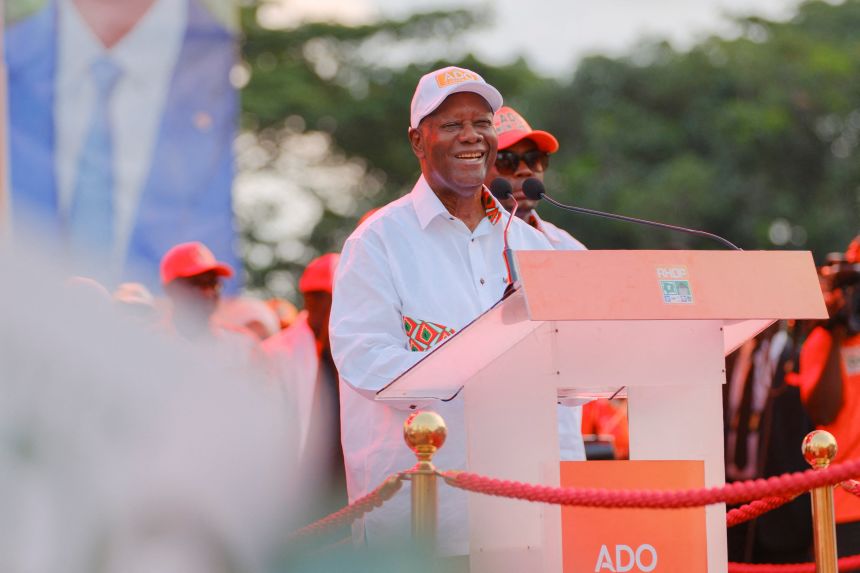
Ivory Coast’s long-serving leader, President Alassane Ouattara, appears headed for another term in office as early results from the weekend’s presidential election show him with a commanding lead nationwide. Opposition candidate and former commerce minister Jean-Louis Billon has officially conceded defeat, congratulating Ouattara on his victory and acknowledging that the incumbent’s lead is “undeniable.”
“The initial results place the incumbent President, Mr Alassane Ouattara, in the lead, designating him the winner of this presidential election,” Billon said in a statement on Sunday, urging calm and calling on Ivorians to respect the democratic process.
The 83-year-old Ouattara, a former International Monetary Fund executive, ran for a fourth term amid a fractured opposition and widespread predictions of an easy win. His victory, while expected, has stirred debate about political succession in West Africa’s third-largest economy, where stability remains fragile after years of political turbulence.
Ivory Coast’s Independent Electoral Commission began announcing partial results from Saturday’s vote on national television, showing Ouattara far ahead of his four rivals in most regions. Reports from polling centers indicate strong voter turnout in the north, the president’s stronghold, while many stations in southern and western opposition areas saw low participation.
Observers say the fragmented opposition gave Ouattara a significant advantage. Billon, who ran as an independent after failing to secure the endorsement of the Democratic Party of Ivory Coast (PDCI) led by Tidjane Thiam, struggled to mobilize broad national support. Thiam, a former Credit Suisse chief, was barred from running due to dual nationality, while former President Laurent Gbagbo was excluded over a criminal conviction — two disqualifications that dramatically reshaped the race.
In the capital Abidjan, calm largely prevailed as vote counting continued under heavy security. Authorities deployed over 44,000 security personnel across the country before, during, and after the election to prevent unrest. Though isolated incidents of violence were reported in a few regions, overall the polls proceeded without the large-scale clashes that have marred past elections.
Pre-election tensions were high after opposition figures condemned the exclusion of key candidates and accused the government of manipulating the electoral process. Some groups even called for a boycott, echoing the events of the 2020 election, when Ouattara claimed victory with 94 percent of the vote amid widespread abstention.
This year’s turnout, estimated at around 50 percent, reflects both voter fatigue and disillusionment among segments of the population, particularly in opposition strongholds. Nevertheless, large crowds reportedly turned out in pro-government regions, reaffirming the president’s enduring political grip.
Ouattara’s party, the Rally of Houphouëtists for Democracy and Peace (RHDP), entered the contest with a strong organizational network and control of most state institutions, making a victory almost certain. None of the opposition candidates possessed the nationwide reach or political machinery to mount a serious challenge.
As the final results are tallied, attention now turns to what Ouattara’s renewed leadership will mean for Ivory Coast’s future. The president has been credited with fostering economic growth and stability since the end of the country’s civil conflict but faces growing criticism over democratic backsliding and his decision to seek a fourth term.
Analysts say his new mandate offers both opportunity and risk the chance to cement his legacy as a unifying figure or to deepen political divisions if reforms and reconciliation are not prioritized.
For now, Ivorians are watching closely and hoping that calm endures. With the opposition’s early concession and the streets of Abidjan quiet, the country appears poised to move past another contentious election at least for now.






Leave a comment