


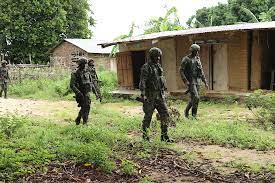
Eight years after the first attacks erupted in Mozambique’s northern Cabo Delgado province, the insurgency that has claimed thousands of lives and displaced nearly a million people shows little sign of abating. Despite sustained military operations by national forces, foreign troops, and private military contractors, violence continues to flare across the region, raising questions about the government’s approach to the crisis.
Analysts warn that the situation is deteriorating, with attacks reported on a near-daily basis and entire communities still living in fear. According to Borges Nhamirre, a consultant at the Institute for Security Studies (ISS), the Mozambican government’s heavy reliance on military force has failed to bring lasting peace. He argues that the state’s narrow focus on security responses has ignored the deeper social, political, and economic grievances driving the rebellion.
“The core reason the insurgency persists is the absence of a holistic strategy that goes beyond the battlefield,” Nhamirre said. “While the insurgents have ties to the Islamic State, the conflict’s roots are primarily local grounded in decades of neglect, exclusion, and poverty.”
Cabo Delgado, rich in natural gas reserves and other resources, has paradoxically become a symbol of inequality in Mozambique. Despite billions of dollars in foreign investment, local communities have seen few tangible benefits. Instead, frustration over unemployment, land dispossession, and poor governance has deepened resentment against the central government in Maputo.
Since 2017, insurgents known locally as al-Shabaab (not linked to the Somali group of the same name) have carried out brutal attacks on towns and villages, killing civilians, burning homes, and destroying infrastructure. In response, the Mozambican government launched multiple offensives, often in partnership with foreign forces, including troops from Rwanda and the Southern African Development Community (SADC).
While these interventions temporarily reclaimed some territories, they have not eradicated the insurgency. Experts note that militants have adapted by shifting tactics, targeting soft civilian populations, and exploiting porous borders to evade capture. Reports from humanitarian agencies describe ongoing displacement, widespread hunger, and trauma among affected populations.
Critics also argue that the government’s counter-insurgency efforts have been marked by human rights abuses, lack of transparency, and weak community engagement factors that further alienate local residents. Without trust and inclusive governance, observers say, military victories are likely to remain fleeting.
The United Nations and regional partners have repeatedly urged Mozambique to adopt a more comprehensive peacebuilding framework, combining security measures with economic investment, reconciliation, and youth empowerment. Yet progress has been slow, with insecurity continuing to disrupt development projects, including the multi-billion-dollar liquefied natural gas operations in the region.
As Cabo Delgado enters its eighth year of violence, many Mozambicans are losing faith in promises of peace. The persistence of the insurgency highlights a sobering reality: without addressing inequality, corruption, and the marginalisation of northern communities, Mozambique’s war on terror may drag on indefinitely at immense human and economic cost.










Leave a comment