


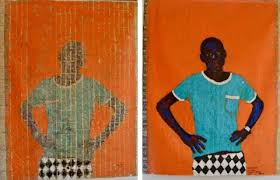
Zambian artist Stary Mwaba is using his latest exhibition at the Lusaka National Museum to tell the powerful stories of young miners risking their lives on Kitwe’s infamous “black mountain,” a toxic legacy of a century of industrial copper and cobalt mining in Zambia. Once a forbidden place where children would sneak in to pick wild fruits, the towering slag heaps have now become a dangerous lifeline for unemployed youth, many digging illegal tunnels to extract copper ore for resale to buyers, often linked to Chinese-owned operations.
With youth unemployment in the Copperbelt hovering around 45%, Mwaba’s vividly colored portraits on perforated newspaper capture the hardship and resilience of the Wusakile community. His subjects include the “jerabos,” or gang masters, the young men lowering themselves into unstable tunnels with makeshift safety ropes, and even children finding joy swinging on repurposed electrical cables stripped of copper wire. Through his unique technique of burning “holes” into newsprint articles and overlaying them with personal stories, Mwaba emphasizes that the “little narratives” of ordinary people are as vital as the grand headlines.
The “black mountain,” filled with toxic heavy metals, has long endangered the environment and health of Kitwe residents. Earlier this year, a catastrophic spill from a nearby Chinese-owned mine contaminated the Kafue River, cutting off water supply to the city of 700,000. Mwaba, whose family has deep mining roots, says the works reflect both survival and fragility, echoing a community living under constant economic and environmental threat.
His inspiration to explore the intersection of mining and identity dates back to 2011, when a science project with his daughter led to his acclaimed “Chinese Cabbage” installation, a symbolic commentary on Chinese influence in Zambia’s mining sector. Today, his focus has shifted to documenting the lived reality of the “black mountain” generation, a haunting testament to poverty, exploitation, and resilience in one of the world’s richest mineral belts.
Mwaba’s work serves as both cultural preservation and social critique, shining a global spotlight on the human cost of Zambia’s mining legacy while amplifying the voices of those too often left out of the country’s economic narrative.









Leave a comment