


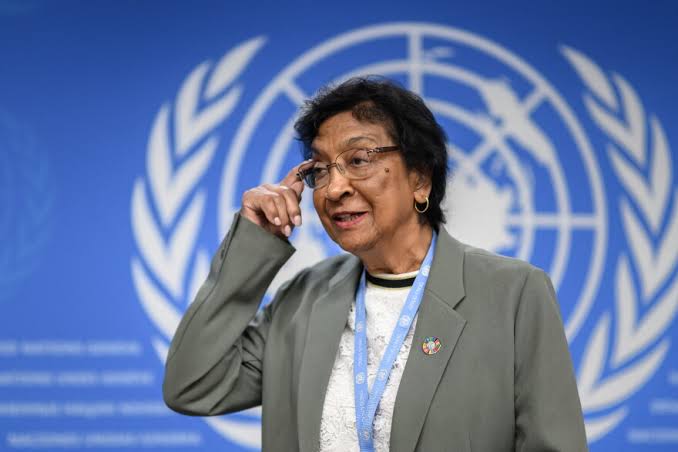
South African human rights lawyer and former United Nations High Commissioner for Human Rights Navanethem “Navi” Pillay has won the 2026 Nobel Peace Prize for her contributions to international justice, human rights protection and the promotion of international law.
The Norwegian Nobel Committee announced the award on Friday, Oct. 9, recognising Pillay, 85, for her decades of work advancing accountability for war crimes, crimes against humanity and genocide. The committee said her work had significantly strengthened the role of international law in resolving conflicts and protecting victims of serious abuses.
The committee said the award underscored the importance of upholding international legal institutions at a time when global conflicts are increasing and the authority of international law is facing mounting pressure.
Pillay’s career has spanned South Africa’s apartheid era and several decades of international judicial and human rights work. Born in Durban in 1941 to a family of Indian Tamil descent, she challenged racial discrimination and defended anti apartheid activists before moving into senior judicial and international human rights roles.
Pillay made history as the first nonwhite woman appointed to South Africa’s High Court. She also became the first woman to establish a law practice in Natal province, where she challenged discriminatory practices and defended people facing abuses under apartheid.
Following the end of apartheid, she served as a judge at the International Criminal Tribunal for Rwanda, which was established to prosecute those responsible for the 1994 genocide.
During her work at the tribunal, Pillay contributed to landmark legal developments recognising that rape and sexual violence could constitute crimes against humanity and acts of genocide under international law. These developments strengthened the legal recognition of sexual violence as a weapon of conflict and expanded protections for victims.
She later served as a judge at the International Criminal Court before becoming United Nations High Commissioner for Human Rights in 2008, a position she held until 2014.
In that role, she advocated for the protection of fundamental rights and called on governments to uphold their obligations under international law.
Pillay has also served as an ad hoc judge at the International Court of Justice, including in proceedings concerning allegations of genocide against Myanmar’s Rohingya population.
In more recent years, Pillay chaired the United Nations Independent International Commission of Inquiry on the Occupied Palestinian Territory, including East Jerusalem, and Israel.
In 2025, the commission concluded that Israel had committed genocide against Palestinians in Gaza. Israel strongly rejected the finding. The report and its conclusions intensified international debate over accountability, the protection of civilians and the application of international law in the conflict.
Pillay’s role in the inquiry has placed her at the centre of contentious international discussions about the responsibilities of states and the authority of international institutions.
The Nobel Committee’s recognition of her work comes amid broader concerns about the ability of international legal bodies to investigate alleged violations, hold perpetrators accountable and provide avenues for justice to victims of armed conflict.
The Nobel Peace Prize carries a monetary award of 12 million Swedish kronor. Pillay will receive the award at the formal ceremony in Oslo on Dec. 10, the anniversary of Alfred Nobel’s death.
Her selection highlights the relationship between human rights protection, accountability and international peace. Supporters of international justice have argued that credible legal institutions can help deter serious abuses, provide remedies for victims and establish mechanisms for addressing disputes without resorting to violence.
For Africa, Pillay’s achievement also brings international attention to a jurist whose career began in the struggle against racial discrimination in South Africa and developed into a prominent role in global human rights institutions.
Her award places the protection of human rights and the enforcement of international law at the centre of this year’s Nobel Peace Prize, reinforcing the debate over how international institutions can maintain their independence and effectiveness amid armed conflicts and political pressure.










Leave a comment