


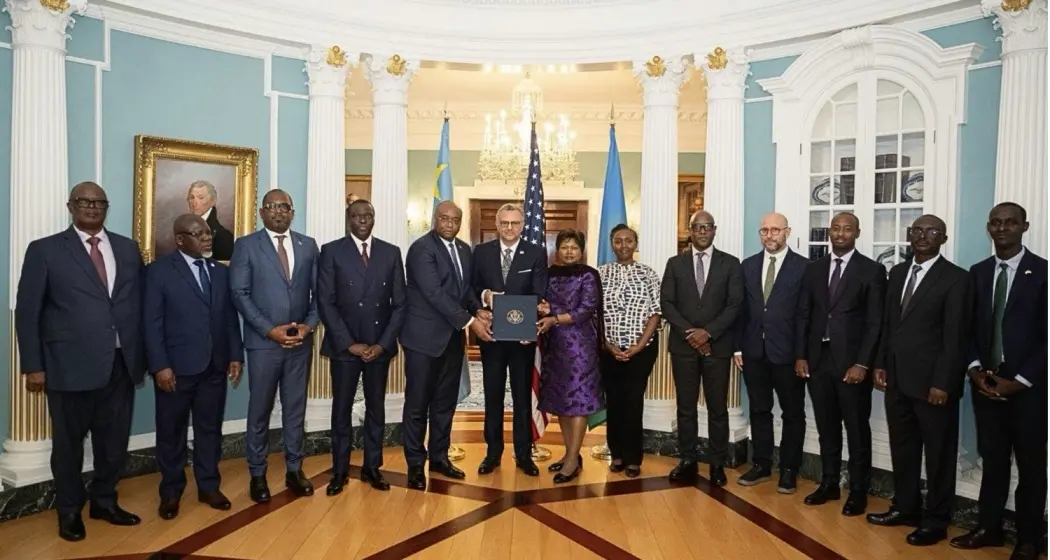
The Democratic Republic of Congo (DRC) and Rwanda are poised to sign a landmark peace agreement in Washington on Friday, a U.S.-facilitated deal aimed at ending decades of devastating conflict in eastern Congo while securing strategic access for American companies to one of the world’s richest untapped reserves of critical minerals.
This historic accord, hailed by former U.S. President Donald Trump as “a Great Day for Africa and the World,” includes key provisions to respect territorial integrity, prohibit hostilities, and dismantle non-state armed groups through disarmament and conditional integration. The U.S. State Department confirmed the agreement will serve as a diplomatic cornerstone for resolving the long-standing tensions that have displaced more than 7 million people and spawned one of the world’s worst humanitarian crises.
Eastern Congo has suffered under the weight of violence from over 100 armed groups. Chief among them is the M23 rebel group, widely reported to be supported by Rwanda a claim Kigali denies, insisting its involvement in the region is solely for national security. The M23 has been linked to mass atrocities, including an offensive earlier this year that left civilians dead and critical cities like Goma and Bukavu on edge. The U.N. estimates Rwanda may have up to 4,000 troops operating inside Congolese territory.
The upcoming deal is part of a wider diplomatic effort, including negotiations led by the African Union and Qatar. However, its implementation is already facing major hurdles: the M23 rebel group, part of the broader Congo River Alliance led by Corneille Nangaa, has rejected the deal, claiming it was negotiated without their direct participation. “Anything regarding us which is done without us, it’s against us,” Nangaa said. M23 spokesman Oscar Balinda echoed the sentiment, stating the group does not recognize the U.S.-mediated agreement.
Despite rebel pushback, Congolese authorities remain hopeful that the deal will bring much-needed international security assistance, enabling them to reclaim territories currently under rebel control. The Congolese government expects the U.S. to support operations that will pressure foreign forces to withdraw and assist in stabilizing the mineral-rich eastern provinces.
American involvement is not without strategic interests. A separate minerals agreement under negotiation is expected to give U.S. companies preferential access to an estimated $24 trillion in untapped mineral wealth, including cobalt, lithium, and tantalum essential components for electric vehicle batteries, smartphones, and military technologies. These resources are key to the global energy transition and technological infrastructure, making Congo a geopolitical hotspot for economic influence.
Political analysts caution that while the peace deal is a significant step forward, it may not resolve deeper systemic challenges. Christian Moleka, a Congolese political scientist, warned the deal appears to bypass accountability for war crimes. “The current draft agreement ignores justice for victims by imposing a partnership between the victim and the aggressor,” Moleka said. “This is a trigger-happy proposition that cannot establish lasting peace without truth and reparation.”
The United Nations has voiced cautious optimism about the agreement. U.N. spokesperson Stephane Dujarric said the organization welcomes any initiative that could ease the suffering of civilians in eastern Congo. “We talk almost every day about the horrific suffering hunger, the sexual violence, the constant fear,” Dujarric said. “Any credible step toward peace is something we must support.”
While the deal signals a rare moment of diplomatic unity in a region scarred by decades of violence, its success will depend heavily on how inclusive the process becomes, how justice is pursued for past atrocities, and whether global powers prioritize peacebuilding over resource extraction. As Congo and Rwanda prepare to sign the deal in Washington, the world watches closely to see if this will mark the beginning of sustainable peace, or another fleeting ceasefire in a long cycle of conflict and exploitation.









Leave a comment