


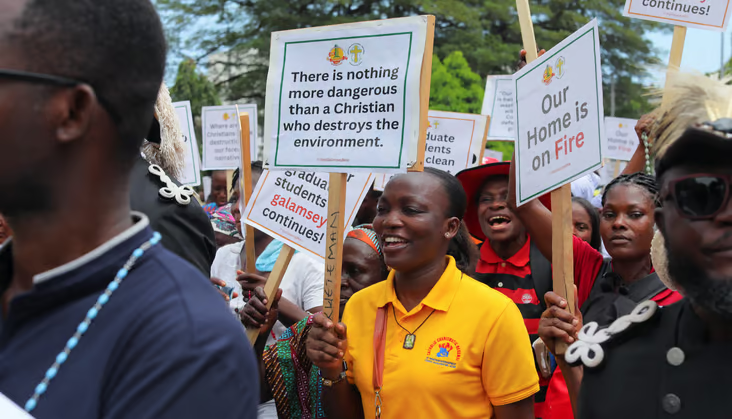
Ghanaian President John Mahama is under growing public and political pressure to repeal Legislative Instrument 2462 (LI 2462), a controversial mining regulation that permits legal mining operations in protected forest reserves. The law, originally passed in November 2022, has sparked outrage among environmental groups, legal experts, and civil society, who argue it threatens Ghana’s forests, biodiversity, water security, and international environmental commitments.
While in opposition, Mahama and his party, the National Democratic Congress (NDC), strongly opposed the law. However, after reclaiming power in January 2025 with a parliamentary supermajority, the government has chosen to amend rather than repeal the regulation. Activists see this as a betrayal of public trust, with over 6,000 Ghanaians signing a petition within one week demanding a full repeal.
Critics warn that the amendment would only protect 10% of Ghana’s forest reserves, compared to a complete repeal that would safeguard over 60%. Environmentalist Daryl Bosu of A Rocha Ghana described the government’s move as “a calculated assault on Ghana’s future,” emphasizing that protected forests are essential for maintaining the nation’s water cycles, food security, and ecosystems.
Illegal mining, commonly known as ‘galamsey,’ continues to devastate Ghana’s environment. The Ministry of Lands and Natural Resources reports that 44 out of 280 forest reserves have been lost to illegal mining, covering over 5,200 hectares. Rivers near mining sites have turbidity levels up to 12,000 NTU—well beyond the Ghana Water Company’s treatable limit of 500 NTU. Communities report vanishing cocoa farms, polluted water sources, and displacement due to mining-related environmental destruction.
Simultaneously, the government’s deportation policy targeting foreign nationals involved in illegal mining has drawn strong criticism. Foreign Affairs Minister Samuel Okudzeto Ablakwa announced the quiet deportation of illegal miners, primarily Chinese and West African nationals, and promised a military-led crackdown. Legal experts argue this approach undermines Ghana’s judicial system and fails to deter criminal networks. Justice Abdulai warned that deportation sends the message that Ghana is not serious about enforcing its laws. Security expert Kwasi Aning added that deporting offenders without trial does nothing to dismantle the powerful syndicates funding illegal mining operations.
The infamous case of Aisha Huang, a Chinese illegal mining kingpin who was deported but later returned and resumed operations, remains a glaring example of the policy’s failure. Critics say it proves that deportation is not a deterrent but an invitation for repeat offenders.
Environmentalists also point to the potential breach of Ghana’s international obligations under the Paris Agreement, the Convention on Biological Diversity, and the national Forest and Wildlife Policy. Losing access to REDD+ climate finance and carbon market incentives could have severe economic implications for Ghana. The forest sector currently contributes 4% to 6% of GDP and supports over 100,000 jobs, which many fear could be wiped out if forest reserves continue to be exploited for mining.
With a clear campaign promise to repeal LI 2462 and the political majority to do so, Ghanaians are increasingly questioning why President Mahama’s government is stalling. The pressure is mounting for the administration to act decisively in defense of Ghana’s environment, legal integrity, and future.








Leave a comment