


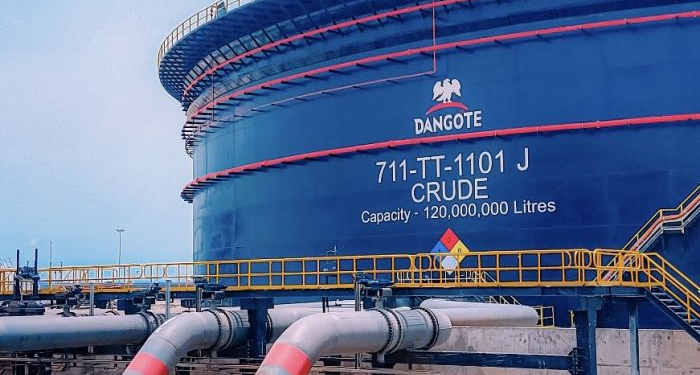
Ghana has set its sights on sourcing petroleum products from Nigeria’s massive Dangote Oil Refinery, a strategic move expected to dramatically cut fuel import expenses by approximately $400 million each month, according to the country’s National Petroleum Authority (NPA) chairman, Mustapha Abdul-Hamid. As the refinery nears full operational capacity, the shift away from costly European imports could deliver major economic benefits to Ghana and other West African economies.
Speaking at the OTL Africa Downstream Oil Conference in Lagos, Abdul-Hamid highlighted the potential cost-saving advantage of sourcing from the Dangote refinery, which, once fully operational, could process up to 650,000 barrels per day (bpd) of crude oil. “If the refinery reaches 650,000 bpd, all that volume cannot be consumed by Nigeria alone, so instead of importing from Rotterdam as we do now, it will be much easier for us to import from Nigeria. I believe that will bring down our prices,” Abdul-Hamid noted. Currently, Ghana’s fuel imports largely come from Europe, an arrangement that incurs high freight and transportation costs, which in turn push up domestic fuel prices.
The $19 billion Dangote refinery, the largest single-train refinery in the world, is poised to become a transformative force in Africa’s energy market. While exports of gasoil from the facility doubled in May to nearly 100,000 bpd, according to Kpler, a global data analytics firm, most of these supplies were directed to West African markets. With full operational capacity expected by early 2025, the refinery promises to significantly reduce West Africa’s reliance on Europe for fuel, potentially shifting the region’s energy supply landscape and reshaping trade routes that have existed for decades.
Beyond cutting costs, sourcing from Dangote’s facility could offer further benefits to Ghana and other African nations, such as lessening currency dependency. Abdul-Hamid suggested that in the long term, the African continent might consider the adoption of a common currency, which would help reduce reliance on the U.S. dollar in regional trade. With a common currency, African nations could handle cross-border transactions with greater efficiency and economic independence, building resilience against global currency fluctuations.
In Ghana, fuel demand continues to grow in tandem with the economy, which reported an impressive 6.9% year-on-year growth rate in the second quarter of 2024, largely driven by a booming extractive sector. As the economy expands, demand for energy resources also intensifies, reinforcing the need for cost-effective and reliable fuel sources. By turning to the Dangote Oil Refinery, Ghana could support its economic growth by ensuring a steady, less costly fuel supply and potentially lower prices for businesses and consumers.
Economists note that the emergence of the Dangote refinery could disrupt the Europe-to-Africa fuel trade, valued at $17 billion annually. For decades, African nations have relied on European imports to meet local fuel demands, paying premium prices due to freight and other associated costs. The Dangote refinery’s regional proximity and substantial capacity could reduce these costs, opening a new chapter in Africa’s energy independence.








Leave a comment