


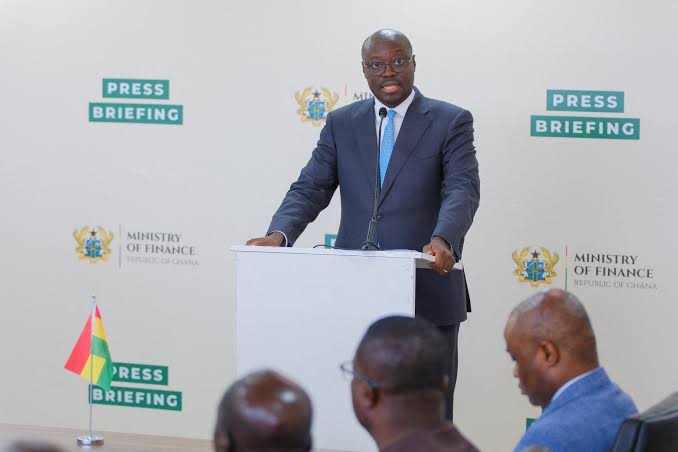
Ghana has unveiled a $10 billion economic transformation programme to be implemented between 2027 and 2030, targeting agriculture, energy, technology, manufacturing and other productive sectors to expand domestic production, boost exports and create jobs.
Finance Minister Cassiel Ato Forson announced the initiative, known as the New Economy Programme, while presenting the 2027 Budget Statement and Economic Policy to Parliament on Thursday, Nov. 12.
The four-year programme will be domestically funded, with the government earmarking 30 billion Ghanaian cedis, equivalent to 1.5 per cent of gross domestic product, for its implementation in 2027.
Forson said the initiative was designed to move the economy beyond stabilisation towards production-led growth, with the private sector playing a central role in investment, innovation and job creation.
The programme is structured around eight pillars: macroeconomic stability and affordable finance; commercial agriculture; energy infrastructure; critical minerals value addition; tourism, culture and creative arts; textiles and garments; pharmaceuticals and biomanufacturing; and the technology economy.
Commercial agriculture is expected to receive $3 billion to develop eight priority value chains: rice, sugar, poultry, maize and soya feed, aquaculture, oil palm, vegetables and cocoa processing.
Under the rice initiative, the government plans to bring an additional 100,000 hectares under cultivation across production hubs in the Afram Plains, Volta Basin, Western Ghana and Northern Ghana. The programme targets yields of five to six metric tonnes per hectare and an estimated 125,000 jobs.
Ghana also aims to achieve sugar self-sufficiency by 2030 and increase domestic cocoa processing to at least 50 per cent by 2028 and 100 per cent by 2030.
The energy component, estimated at $2.2 billion, will focus on expanding electricity generation, strengthening transmission infrastructure and reducing power costs.
Plans include a 1,450-megawatt thermal power plant in the Central Region, a 600-megawatt solar facility supported by battery storage and a $500 million investment in modernising the electricity transmission network.
The government also intends to provide two million prepaid electricity meters and end reliance on emergency power plants by 2030.
Another $1.5 billion is earmarked for critical minerals, with an emphasis on processing resources locally rather than exporting them in raw form. The targets include refining all artisanal and small-scale gold locally by December 2028 and achieving full domestic processing of manganese and bauxite by the end of 2030.
The tourism, culture and creative arts sector is expected to attract $1 billion to support heritage tourism, conference infrastructure, medical tourism and the development of a year-round visitor economy.
Other components will support the textiles and garments industry, pharmaceutical manufacturing, biomanufacturing and technology development.
The 2027 budget projects economic growth of 5.2 per cent next year, compared with an estimated 4.8 per cent in 2026. The government is targeting a cash-based fiscal deficit of 3.6 per cent of GDP, down from 4 per cent in 2026.
It also plans to maintain inflation within an 8 per cent target, with a margin of two percentage points above or below.
The budget is Ghana’s first since the country completed its $3 billion International Monetary Fund (IMF) support programme. The arrangement followed a severe economic crisis that saw inflation peak at 54.1 per cent in December 2022 before declining significantly during the three-year programme.
Forson also announced plans to accelerate debt repayments. The government will redeem 29 billion cedis in Domestic Debt Exchange Programme bonds due in February 2027 ahead of schedule and repay a restructured Eurobond due in January 2027 by Dec. 31.
The early repayments are expected to retire more than 36 billion cedis in debt ahead of their scheduled maturity.
The New Economy Programme reflects the government’s intention to reduce dependence on imported goods, strengthen local manufacturing and retain more value from Ghana’s natural resources.
President John Dramani Mahama has described the initiative as a strategy to build an economy that produces more of what it consumes, processes more of what it grows and earns more from its exports.
The government says projects will undergo appraisal and value-for-money assessments, with public support linked to measurable outcomes.
The programme’s impact will depend on how effectively the government mobilises the proposed financing, attracts private investment and delivers the infrastructure and industrial projects within the four-year period.





Leave a comment