


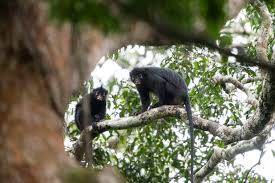
Scientists have identified a previously unknown species of monkey in the rainforests of the Democratic Republic of Congo, marking one of the most significant primate discoveries in Africa in decades. The newly described species, known locally as “Likweli” and scientifically named Colobus congoensis, is only the fifth new monkey species discovered on the continent in the past 75 years.
The monkey is distinguished by its glossy black fur and striking orange cream patches around its mouth and nose, giving it a distinctive mask-like appearance. Researchers also found that it produces unique roaring calls with an acoustic structure different from those of other colobus monkeys, helping confirm that it is a separate species.
The discovery followed years of fieldwork in the remote forests of Lomami National Park. Although local communities had long known of the animal and called it “Likweli,” scientists only confirmed its status as a new species after conducting detailed genetic analyses and extensive observations between 2018 and 2022.
Researchers say the finding highlights the extraordinary biodiversity of the Congo Basin, the world’s second largest tropical rainforest, and underscores how much of the region’s wildlife remains undocumented. They also warned that the newly identified monkey already faces threats from hunting and habitat loss due to its limited geographic range.
The research team has recommended that the International Union for Conservation of Nature (IUCN) classify Colobus congoensis as an endangered species to support conservation efforts. Scientists hope the discovery will encourage greater protection of Lomami National Park and further exploration of one of Africa’s richest and least studied ecosystems.











Leave a comment