


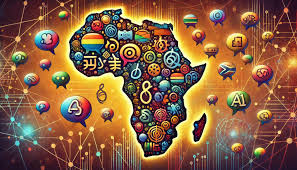
Africa is the most linguistically diverse continent in the world, with an estimated 2,000 languages spoken across its 54 countries. Yet, despite this richness, African languages have long been left out of technological innovation, especially in artificial intelligence (AI). While global AI models such as ChatGPT and other popular tools are trained primarily on English, European, and Chinese languages which have massive volumes of online text to draw from, many African languages remain sidelined. The reason is simple: most African languages are oral rather than written, leaving behind very little digital text that AI systems can learn from.
This lack of representation has profound consequences. Technology is not just about convenience; it shapes the way people interact with the world. As Professor Vukosi Marivate of the University of Pretoria explains, “We think in our own languages, dream in them, and interpret the world through them. If technology doesn’t reflect that, a whole group risks being left behind.” Millions of Africans risk exclusion from the benefits of AI simply because their languages are missing in the datasets used to build modern tools.
To bridge this gap, researchers across the continent have collaborated to create what is thought to be the largest-ever dataset of African languages. The initiative, known as African Next Voices, brought together linguists and computer scientists with one common goal: to ensure African voices are included in the global AI revolution. Over a period of two years, the team recorded more than 9,000 hours of speech across Kenya, Nigeria, and South Africa. These recordings covered everyday scenarios in farming, healthcare, and education, ensuring the data truly reflected real-life African experiences.
The dataset spans 18 African languages, including Kikuyu and Dholuo in Kenya, Hausa and Yoruba in Nigeria, and isiZulu and Tshivenda in South Africa. Some of these languages are spoken by millions, while others are regional, but all carry cultural depth and nuance that had previously been ignored in AI development. According to Prof. Marivate, the goal was to create a foundation: “You need some basis to start off with, and that’s what African Next Voices is. From there, people can build on top of it and add their own innovations.”
The project was made possible through a $2.2 million grant from the Bill & Melinda Gates Foundation, a recognition of how critical linguistic inclusion is for Africa’s digital future. Importantly, the dataset will be open access, meaning developers, startups, researchers, and even students can use it freely to build new projects.







Leave a comment