


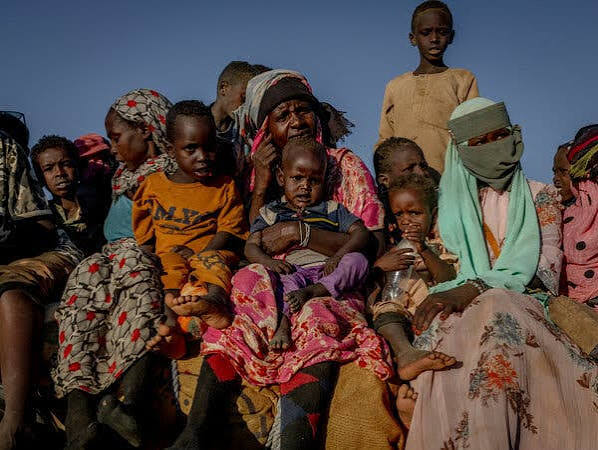
The United Nations has warned that a new report by its Fact-Finding Mission for Sudan provides further evidence that atrocities being committed by warring parties in the country carry markers of genocide. The findings, presented to reporters in New York on Wednesday by Secretary-General spokesperson Stéphane Dujarric, represent one of the most serious formal assessments yet of what is unfolding in Sudan, where civilians have borne the brunt of a conflict that shows no sign of abating.
The report focuses in particular on the conduct of Sudan’s Rapid Support Forces, known as the RSF, whose actions in el-Fasher the Fact-Finding Mission described as brutal and systematic. According to Dujarric, the Mission documented mass killings, systematic abductions of women and girls, and mass gang rapes carried out by the RSF in the city. These are not isolated incidents. They form a pattern of violence directed at civilian populations that the Mission has now formally characterised as bearing the markers of genocide.
The situation is not confined to el-Fasher. The Fact-Finding Mission warned that similar patterns of violence and devastation are now emerging in el-Obeid, a development that signals the geographic spread of the most extreme forms of harm to new population centres. In response, the Mission has launched an urgent inquiry into alleged human rights violations and abuses in el-Obeid, following a resolution passed by the Human Rights Council earlier this week. The speed of that response reflects the urgency with which the UN is treating what is unfolding there.
The Fact-Finding Mission also reiterated its calls for effective accountability, including prompt cooperation with the International Criminal Court. That call carries weight given the gravity of what has been documented, but also a degree of frustration, as calls for ICC involvement in Sudan-related crimes are not new and the mechanisms of international accountability have historically moved far more slowly than the pace of atrocities on the ground.
Dujarric closed his briefing with a clear statement of the Mission’s mandate and intention. “As civilians continue to bear the brunt of the conflict, the Fact-Finding Mission will continue its investigations and will report on the situation in and around el-Obeid to the Human Rights Council and the General Assembly, as it is mandated to do,” he said. The commitment to continued investigation is important. Documentation is the foundation of accountability, and in a conflict where access is limited and the international community’s attention is contested by other crises, maintaining a systematic record of what is happening to Sudanese civilians is itself a form of resistance against impunity.
Sudan has been engulfed in conflict since fighting broke out between the Sudanese Armed Forces and the RSF in April 2023. The war has produced one of the world’s worst humanitarian crises, displacing millions of people and leaving large parts of the country without functioning health, water, or food systems. The finding that the violence now carries markers of genocide adds a legal and moral dimension to a crisis that has already been catastrophic in purely humanitarian terms. It is a finding that demands a response commensurate with its gravity, from the international community, from the ICC, and from every government with the influence to apply pressure on the parties to this conflict.









Leave a comment