



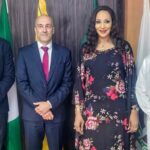
Nigeria and the Czech Republic are moving to take their longstanding diplomatic relationship to a new and more structured level, with both governments signalling a clear appetite for deeper engagement across trade, technology, agriculture, healthcare, education, and renewable energy. The signal came on Tuesday, 26th May 2026, during a high-level meeting at the Ministry of Foreign Affairs in Abuja, where Nigeria’s Foreign Minister, Ambassador Bianca Odumegwu-Ojukwu, received Czech Republic Ambassador Tomas Vyprachticky.
The meeting was warm in tone but serious in substance, a reflection of two countries that share a longer history than many might assume and that are now intent on building on that foundation in ways that are practical, measurable, and mutually beneficial.
Ambassador Vyprachticky opened proceedings by congratulating Minister Odumegwu-Ojukwu on her appointment and conveying the goodwill of the Czech government for continued and expanded engagement with Nigeria. His remarks were not merely ceremonial. He spoke at length about the Czech Republic’s commitment to broadening cooperation across a wide range of critical sectors including agriculture, investment, industrialisation, healthcare, renewable energy, education, innovation, and technical cooperation. He described Nigeria as a strategic partner of immense political and economic significance within Sub-Saharan Africa. That framing matters: it positions Nigeria not merely as a recipient of development partnership but as a country whose scale, ambition, and potential make it a genuinely important ally for a mid-sized European nation looking to deepen its global commercial and diplomatic footprint.
Officials from the Czech Embassy went further, highlighting concrete and ongoing cooperation projects across multiple Nigerian states including Taraba, Delta, Edo, Ondo, Bauchi, Plateau, Lagos, Rivers, and Zamfara. Perhaps the most tangible example of what this partnership can look like in practice was the delivery of nearly 1,000 specially designed tractors and agricultural equipment to Taraba State in 2024, machinery engineered collaboratively by experts from both countries to support mechanised farming and boost agricultural productivity in a state with significant untapped agricultural potential. It is the kind of project that rarely makes international headlines but quietly changes lives on the ground.
Minister Odumegwu-Ojukwu, for her part, did not come to the meeting simply to receive compliments. She came with ideas. Recalling the historically warm relations between Nigeria and the former Czechoslovakia, particularly in the areas of industrialisation, technical cooperation, educational exchange, and machinery supply, she made the case that the two countries now need more than goodwill to sustain and deepen their partnership. They need architecture. She proposed the strengthening and revitalisation of bilateral frameworks, including the formal establishment of a Joint Commission mechanism to coordinate cooperation across trade, agriculture, defence, education, technology, and industrial development.
That proposal is significant. Joint Commissions are the institutional backbone of serious bilateral relationships, structured forums that ensure cooperation does not depend on the goodwill of any single ambassador or minister but is instead embedded in a durable framework that survives changes in government and personnel. The fact that Nigeria is pushing for one signals that Abuja sees this relationship as worth investing in for the long term, not merely as a convenient diplomatic talking point.
The timing is also notable. Nigeria is in the midst of a broad economic reform agenda that requires significant foreign investment, technology transfer, and international partnerships to succeed. Agriculture, renewable energy, and industrialisation, three of the sectors central to Tuesday’s discussions, are precisely the areas where Nigeria needs the kind of targeted, technical cooperation that the Czech Republic has shown it can deliver. For Prague, deepening ties with Africa’s largest economy offers both commercial opportunity and diplomatic standing at a moment when European nations are increasingly recognising that their relationships with African countries need to be recalibrated, renegotiated, and reinvigorated.
Both sides left the meeting expressing satisfaction with the trajectory of the relationship and reaffirming their commitment to expanding cooperation. The next step, and the one that will determine whether Tuesday’s meeting amounts to something lasting, is translating those expressed commitments into signed frameworks, funded projects, and joint institutions that actually function. If the tractor deliveries to Taraba State are any guide, there is reason for cautious optimism. The two countries have shown they can move from words to action. The question now is how far and how fast they are willing to go.







Leave a comment