


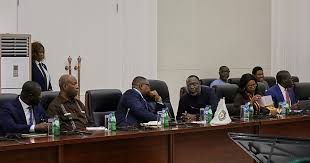
West African leaders have firmly rejected a transition programme announced by Guinea Bissau’s military authorities, insisting instead on a rapid return to constitutional rule and warning that individuals obstructing the process could face targeted sanctions. The stance was reinforced during the sixty eighth summit of the Economic Community of West African States held on Sunday in Abuja, Nigeria, against a backdrop of rising insecurity, economic strain and persistent political instability across the region.
Opening the high level meeting, ECOWAS Commission Chairman and President of Sierra Leone Julius Maada Bio delivered a strong message on the dangers posed by unconstitutional changes of government. He reminded leaders that the foundations of ECOWAS were built on the understanding that democracy, peace, justice and development are inseparable. According to him, the renewed wave of coups and military takeovers represents a direct threat not only to regional stability but also to the rights and aspirations of West African citizens.
President Bio pointed specifically to the situation in Guinea Bissau, alongside a recent attempted coup in Benin, as clear warnings that democratic governance in West Africa cannot be taken for granted. He stressed that safeguarding constitutional order requires constant vigilance, unity of purpose and principled action by all member states.
Nigeria’s Vice President Kashim Shettima, representing President Bola Tinubu, echoed the call for unity and restraint while urging leaders to recommit to regional solidarity. In his address, Shettima described West Africa as more than a collection of neighbouring states, portraying it as a family bound by shared history, culture, struggle and collective ambition. He acknowledged that disagreements among member states are inevitable but argued that such differences must not weaken the sense of belonging or common destiny.
Shettima emphasized that Nigeria believes dialogue and fraternity should guide ECOWAS engagements, even in moments of political tension. He cautioned against approaches that could further fracture the region, noting that lasting solutions lie in cooperation rather than coercion.
Beyond political developments, the summit also focused on economic and developmental priorities. Leaders reviewed progress on regional integration initiatives such as the ECOWAS Trade Liberalization Scheme, cross border energy cooperation and key infrastructure projects designed to boost trade and connectivity. Climate change featured prominently in discussions, with heads of state highlighting its growing impact on food security, especially through recurring floods and prolonged droughts affecting millions across the region.
The meeting took place amid ongoing negotiations between ECOWAS and several military led governments that have either suspended their participation in the bloc or formally withdrawn. These developments have raised serious questions about the future cohesion and effectiveness of the regional body at a time when collective action is increasingly needed.
Founded in nineteen seventy five, ECOWAS brings together fifteen member states with a mandate to promote economic integration, peace and political stability across West Africa. As leaders departed Abuja, the message was clear: the bloc intends to hold firm on its democratic principles while seeking to preserve unity in a region facing one of its most challenging periods in decades.








Leave a comment