


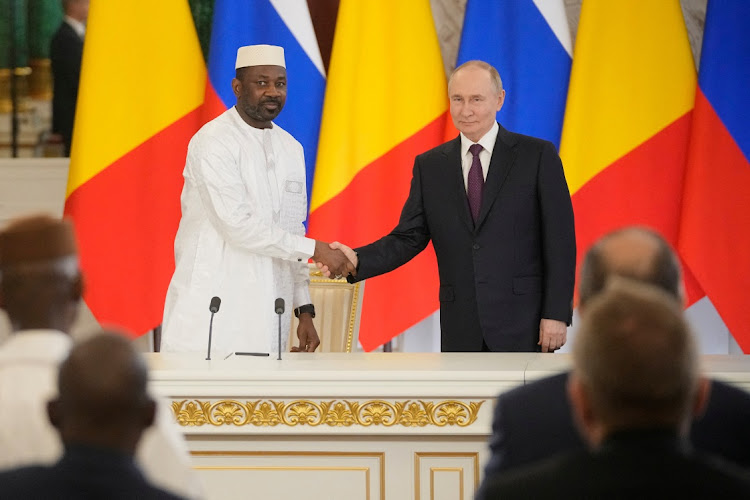
In a significant move to bolster bilateral relations, Mali and Russia have signed a series of far-reaching agreements focused on expanding trade, strengthening security cooperation, and advancing nuclear energy development. The announcement came during an official state visit to Moscow by Mali’s transitional president and military leader, Colonel Assimi Goïta, who met with Russian President Vladimir Putin for high-level talks.
According to the Kremlin, the newly signed agreements underscore a shared commitment to deepening economic, technological, and military ties between the two countries. Notably, the pacts include a pledge to pursue joint efforts in nuclear energy, including the possible construction of a Russian-designed nuclear power plant to address Mali’s chronic energy deficits.
President Putin acknowledged that current trade volumes between Russia and Mali are relatively modest but noted that “there is a steady upward trend” and pointed to new opportunities in sectors such as geological exploration, energy infrastructure, logistics, and humanitarian support. These areas, he said, would form the cornerstone of the next phase of economic collaboration between the two nations.
Col Goïta, who has ruled Mali since leading a military coup in 2021, emphasized that the agreements reflect “mutual trust” and a “respect for sovereignty,” marking a new chapter in Mali’s foreign policy. In a statement from the Malian presidency, he described the Russian reception as warm and reaffirmed his government’s desire to broaden cooperation “across many sectors.”
The visit also included separate meetings between Russian Defence Minister Andrei Belousov and Mali’s Defence Minister Sadio Camara. The focus was on enhancing military capabilities, reinforcing national sovereignty, and ensuring internal stability in Mali, a country still grappling with the fallout of a prolonged insurgency.
Russia’s involvement in Mali’s military affairs has grown significantly since French and United Nations troops were expelled following the military coup. The infamous Wagner Group was initially deployed to support Goïta’s regime, providing tactical and combat support. Although Wagner has since withdrawn, its successor, the Africa Corps a restructured Russian paramilitary force continues to operate in the region, maintaining Russia’s strategic footprint.
Col Goïta has steadily distanced Mali from its former colonial power, France, and pivoted toward Moscow as part of a broader West African trend. Neighboring countries such as Burkina Faso and Niger, both of which experienced recent coups, have also realigned their geopolitical ties toward Russia, rejecting Western influence and forming a regional alliance with Mali based on military governance and mutual security concerns.
Despite the promises of greater stability made by Mali’s military leadership at the time of the coup, violence and insecurity have escalated in recent years, particularly in northern and central regions. The UN has called the security situation “deeply concerning,” with jihadist groups and local militias continuing to carry out deadly attacks.
Russian Defence Minister Belousov emphasized that the Mali-Russia partnership was designed to yield “practical results” in improving security and safeguarding sovereignty. “This approach is the key to any success and victory,” he said, according to remarks quoted by AFP.
The evolving Russia-Mali alliance marks a pivotal shift in Africa’s geopolitical landscape. As Western influence recedes in parts of the Sahel, Russia appears poised to fill the vacuum through economic investment, energy partnerships, and robust military support all under the banner of mutual respect and non-interference in domestic affairs.
The strategic agreements signed during Goïta’s Moscow visit are expected to lay the groundwork for more comprehensive collaboration, positioning Russia as a long-term partner in Mali’s efforts to achieve energy independence, national security, and economic resilience.





Leave a comment