


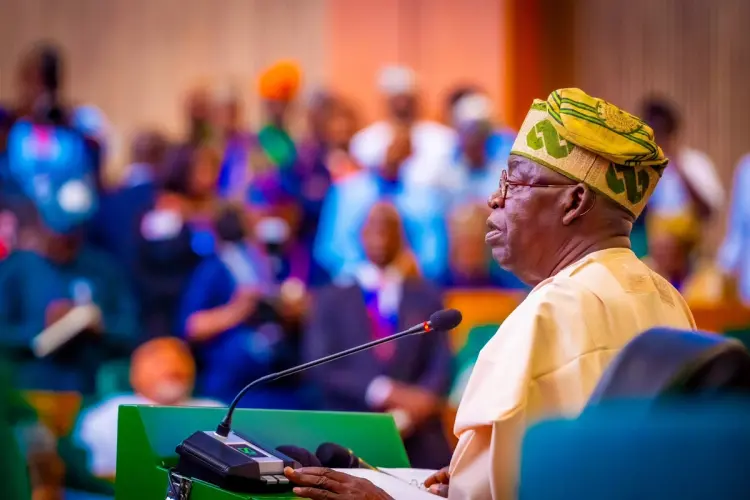
Nigeria’s President Bola Ahmed Tinubu has unveiled a N47.9 trillion ($30 billion) budget proposal for 2025, emphasizing ambitious economic recovery goals despite lingering economic headwinds.
The proposal, presented to the National Assembly on Wednesday, marks Tinubu’s second budget submission since assuming office in 2023. The budget framework relies heavily on oil revenues, underscoring the continued significance of crude oil exports to Africa’s largest economy.
Tinubu’s 2025 budget assumes a benchmark oil price of $75 per barrel and an average production level of 2.09 million barrels per day (bpd). These targets, while optimistic, are met with skepticism from industry analysts. Nigeria has consistently struggled to meet oil production quotas due to infrastructure decay, oil theft, and operational disruptions in its oil-producing regions. Analysts warn that achieving the production level could prove challenging without urgent reforms.
The president’s fiscal plan also projects inflation to decline sharply from its current rate of 34% to 15% by the end of 2025. Economic experts, however, have expressed caution regarding this outlook. Ibukun Omoyeni, an economist at Lagos-based Vetiva Capital, labeled the inflation target as “an optimistic forecast,” pointing out that existing structural challenges, such as food and energy inflation, may keep prices elevated longer than anticipated.
“Inflation may be much higher than the government’s projections,” Omoyeni explained, adding that a supplementary budget could be required to adjust spending priorities if inflationary pressures persist into 2025.
Focus on Defense, Education, and Healthcare
Tinubu described the budget as “ambitious but necessary” for Nigeria’s long-term stability and growth. In his address, the president emphasized the importance of balancing fiscal discipline with social investment, noting the budget’s focus on defense, security, education, and healthcare.
- Defense and Security: The proposed spending allocates 10% of the budget—approximately N4.8 trillion—to defense and security. This reflects the government’s intent to combat insurgency, banditry, and other internal security threats that continue to disrupt economic activities, particularly in the North and oil-producing regions.
- Education and Health: Education and healthcare will receive 7% and 5% of the proposed budget, respectively. While these allocations represent marginal increases compared to previous years, they remain below the global benchmarks recommended by organizations such as UNESCO and the World Health Organization.
The limited spending on education and health underscores broader fiscal constraints, raising questions about the government’s ability to deliver on key social programs amid competing priorities.
Since taking office, Tinubu has pushed forward with a bold policy agenda, including the removal of fuel subsidies and the unification of exchange rates—moves aimed at stabilizing Nigeria’s economy in the long term but which have significantly increased the cost of living. Inflation has surged to its highest levels in decades, eroding purchasing power and worsening poverty for millions of Nigerians.
Public reaction to the new budget remains mixed. While some applaud its focus on security and fiscal consolidation, others highlight its limited impact on immediate relief for struggling households. Critics argue that more needs to be done to alleviate economic hardships and drive investments in critical infrastructure.







Leave a comment