


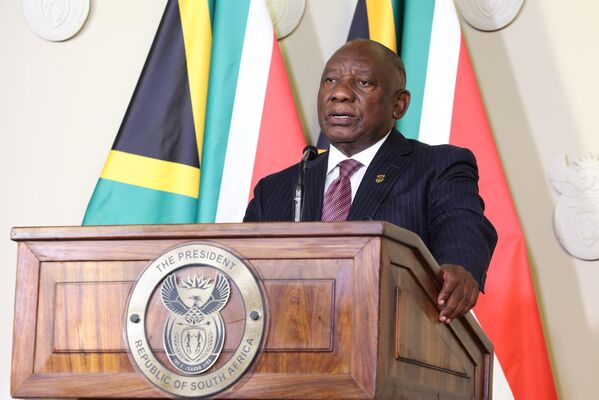
South Africa’s President Cyril Ramaphosa has pledged to support Nigeria’s potential bid to join the G20, emphasizing the necessity of amplifying Africa’s voice within the influential intergovernmental forum. Speaking at the official launch of South Africa’s presidency of the G20 in Cape Town, Ramaphosa expressed enthusiasm for Nigeria’s aspirations and reiterated his commitment to strengthening Africa’s representation on the global stage.
“Nigeria will be keenly supported by us. We have been a lone member of the G20. We shall need to raise the voice of Africa, which has been neglected for far too long,” Ramaphosa declared. His remarks underscore South Africa’s readiness to champion broader African inclusion in global decision-making platforms.
Pretoria made history on Sunday by assuming the presidency of the G20, marking the first time an African nation leads this influential grouping of the world’s largest economies. South Africa’s leadership comes at a pivotal moment as the African Union (AU) officially joined the G20 as a permanent member in 2023, solidifying the continent’s presence within the forum.
South Africa has been the sole African member of the G20 since joining in 1999, a position that has placed significant responsibility on Pretoria to represent the diverse interests and challenges of the entire continent. Ramaphosa’s tenure as G20 president is widely anticipated to focus on advocating for Africa’s developmental priorities, economic resilience, and equitable global policies.
Reports indicate that Nigeria has formally expressed its interest in joining the G20. Local media revealed that the Nigerian government approached South Africa to seek its backing for the bid, signaling its ambition to secure a seat at one of the world’s most influential economic tables.
As Africa’s most populous nation and its largest economy, Nigeria’s inclusion in the G20 could bring substantial weight to the continent’s representation. The West African powerhouse has consistently championed regional and global integration, and membership in the G20 would enhance its capacity to shape international policies affecting trade, climate change, and economic stability.
Africa’s representation in the G20 is currently limited to South Africa and the African Union, which joined as a full member last year. While the AU’s inclusion was celebrated as a landmark achievement, experts and policymakers have argued that broader African membership is essential for truly equitable representation.
President Ramaphosa’s support for Nigeria’s bid reflects a broader Pan-African vision of unity and collaboration. “Africa’s time is now,” Ramaphosa has often asserted, underscoring the urgency of addressing global inequalities and ensuring that African nations have a greater say in shaping the world’s economic and political future.
The inclusion of additional African countries like Nigeria would not only strengthen Africa’s collective voice but also allow for more diverse perspectives on the continent’s unique challenges and opportunities. From addressing climate vulnerabilities to tackling debt sustainability and fostering innovation, Nigeria’s membership could enrich G20 discussions with fresh insights and actionable solutions.
As South Africa embarks on its G20 presidency, the spotlight is firmly on Africa’s capacity to leverage its growing influence to achieve tangible outcomes. Ramaphosa has already signaled that Africa’s priorities—such as fair financing mechanisms, infrastructure development, and climate resilience—will take center stage during his tenure.
For Nigeria, the prospect of G20 membership aligns with its strategic goals of economic diversification, global influence, and regional leadership. If successful, its inclusion would mark another milestone in Africa’s journey toward greater global agency and partnership.
As Africa’s presence on the world stage expands, the continent’s leaders face a critical moment to translate representation into meaningful impact. The collaborative momentum between South Africa and Nigeria may well signal a new era of unity and assertiveness for Africa in international affairs.









Leave a comment