


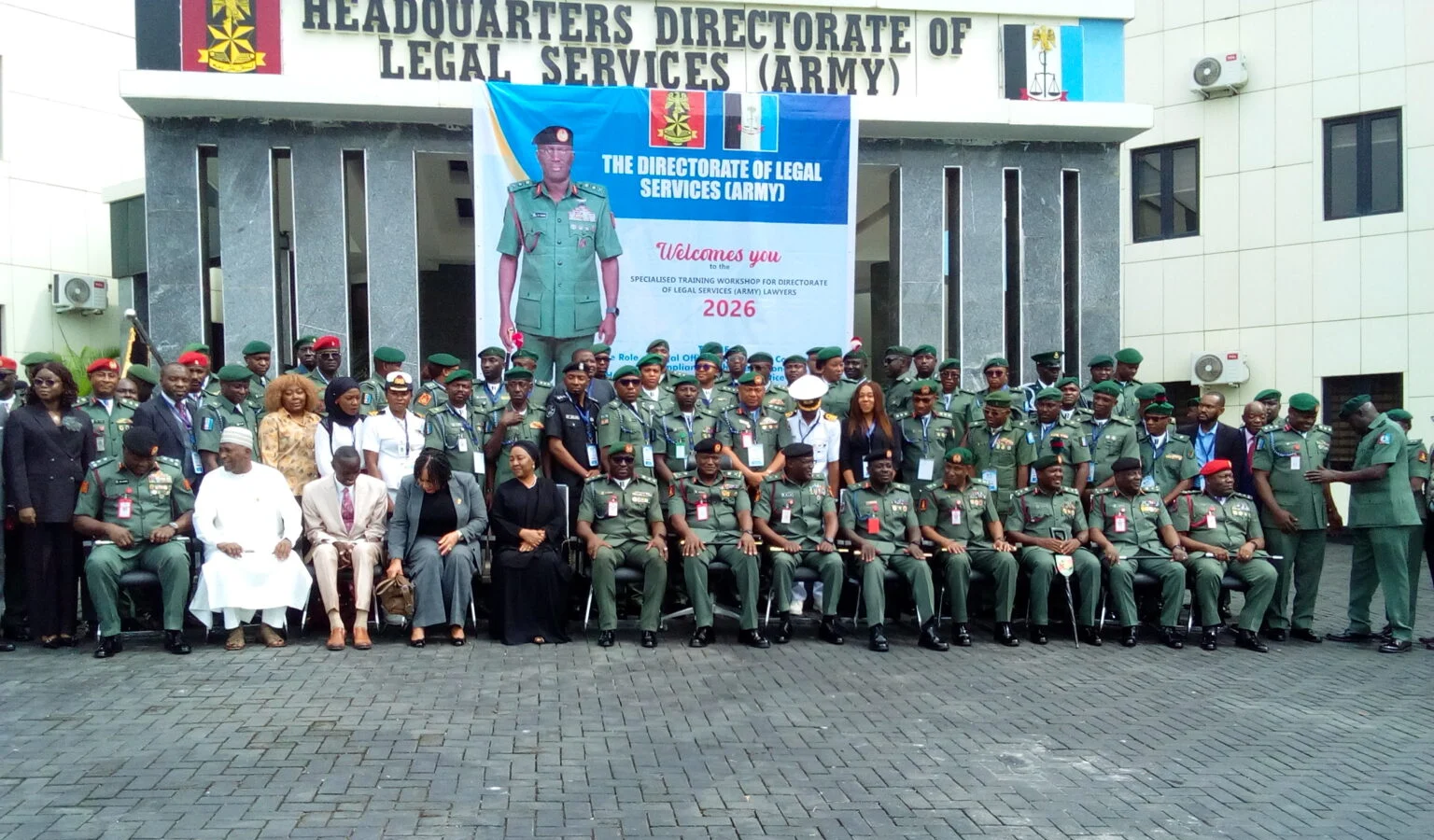
The Chief of Army Staff, Lt. Gen. Waidi Shaibu, has tasked legal officers of the Nigerian Army with ensuring strict adherence to national and international laws during military operations.
Shaibu gave the charge on Tuesday, Oct. 6, 2026, in Abuja while declaring open a specialised training workshop for officers of the Directorate of Legal Services of the Nigerian Army. He was represented at the event by the Chief of Administration, Maj. Gen. Isa Abdullahi.
The five day workshop, organised by the Directorate of Legal Services, is themed, “The Role of Legal Officers in Advising Commanders on Compliance with International Humanitarian Law and the Military Justice System.”
The Army chief said the expansion of the Nigerian Army, including the establishment of new formations and units and its growing operational presence across the country, required stronger institutional mechanisms to ensure compliance with International Humanitarian Law, human rights standards and military justice.
Shaibu said military lawyers must provide commanders with timely, practical and operationally relevant legal advice at the strategic, operational and tactical levels.
He stressed that commanders must be able to translate constitutional provisions, applicable international law, military statutes and rules of engagement into lawful decisions, particularly in complex security environments.
The COAS also said legal officers should be integrated into operational planning and decision making rather than being consulted only after incidents occur.
He described effective legal support as an important component of the Army’s broader transformation into a professional, adaptable, combat ready and resilient force.
Shaibu further tasked Army lawyers to deepen their knowledge of emerging legal issues associated with counterinsurgency, counterterrorism, cyber operations, detention, targeting and joint operations with other security agencies.
He said military legal officers had a dual responsibility to safeguard discipline within the force while ensuring that the application of military power remained anchored on the rule of law.
The Acting Director of Legal Services, Col. Samson Okebukola, said the workshop would strengthen the capacity of legal officers to understand operational realities and provide appropriate legal guidance to commanders on the application of International Humanitarian Law and military support to civil authorities.
Okebukola described military lawyers as custodians of the rule of law within the armed forces, saying their responsibilities included integrating legal considerations into operational planning, execution, discipline and accountability.
He said the Nigerian Army’s commitment to lawful operations included compliance with International Humanitarian Law and the fundamental rights guaranteed under Chapter Four of the 1999 Constitution during internal security operations.
He specifically cited Operation Hadin Kai in the North East and Operation Fansan Yamma in the North West as operational environments where legal officers must provide commanders with appropriate guidance on the application of relevant laws.
Okebukola also emphasised the importance of fair trial and procedural justice within the military justice system, which operates through summary trials and courts martial under the Armed Forces Act, the Constitution and other applicable laws.
He said military lawyers serving as prosecutors, defence counsel or operational legal advisers had a responsibility to safeguard rights while helping commanders distinguish between legitimate tactical necessity and unlawful conduct.
The emphasis on legal compliance comes as the Nigerian Army continues to operate across multiple security theatres and expand its formations and operational footprint. Strengthening legal support within the command structure is intended to help commanders make operational decisions that balance military effectiveness with constitutional obligations, civilian protection and accountability.









Leave a comment