


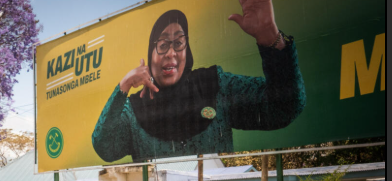
Tanzanians are heading to the polls in a highly anticipated general election that many believe will extend the Chama Cha Mapinduzi (CCM) party’s six-decade rule. The election, taking place on Wednesday, will decide the country’s next president, as well as members of parliament and local councillors but with key opposition figures barred from running, analysts say the vote is all but decided in favor of President Samia Suluhu Hassan.
The 65-year-old incumbent, who became Tanzania’s first female president after the death of John Magufuli in 2021, is widely expected to secure a decisive victory. Rights groups say her strongest challengers, Tundu Lissu of the Chadema party and Luhaga Mpina of ACT-Wazalendo, were disqualified from contesting the race, leaving voters with limited options and effectively removing any serious competition.
Despite a field of multiple candidates, observers say Hassan’s dominance is unchallenged, with her campaign rallies blanketing the country and her face plastered across billboards from Dar-es-Salaam to Dodoma. The government has declared election day a public holiday to encourage voter participation, with more than 37 million registered voters expected to cast their ballots.
The elections cover Tanzania’s 29 mainland regions and the autonomous islands of Zanzibar, where early voting began on Tuesday. Voters will select a president, members of parliament, and local councillors, with winners determined by a simple majority vote.
Hassan’s rise to power in 2021 marked a historic moment for Tanzania, making her not only the nation’s first female head of state but also one of just two women currently leading an African country — the other being Namibia’s Netumbo Nandi-Ndaitwah. A native of Zanzibar and a former trade minister, Hassan initially won praise for steering the country in a more open direction after the isolationist policies of her predecessor.
Upon taking office, she reversed Magufuli’s controversial stance on COVID-19, re-engaged with the World Health Organization, and allowed international vaccine cooperation through the COVAX facility. She also lifted a six-year ban on political rallies and sought to repair relations with the opposition.
However, optimism about a more democratic Tanzania has faded. Amnesty International and other human rights organizations report that Hassan’s government has increasingly turned to repressive tactics, targeting activists, journalists, and opposition members through arrests, intimidation, and disappearances. Critics say the election is being held under an atmosphere of fear and control, stifling dissent and undermining the credibility of the process.
Still, Hassan retains strong domestic support for her focus on infrastructure development and economic modernization. Under her leadership, Tanzania has continued and expanded major public works projects, including railway construction, rural electrification, and efforts to boost education and access to healthcare. Her administration has also sought to strengthen Tanzania’s global partnerships and attract foreign investment, positioning the nation as one of East Africa’s fastest-growing economies.
Tanzania, home to iconic landmarks like Mount Kilimanjaro, the Serengeti, and the Ngorongoro Crater, relies heavily on tourism, agriculture, and mineral exports, including gold and the rare blue gemstone tanzanite. The East African nation of 60 million people is often hailed for its natural beauty and relative political stability, but the latest election underscores concerns about shrinking democratic space.
As polls open, the mood across the country is a mix of resignation and quiet anticipation. For many Tanzanians, the outcome seems predetermined a continuation of the CCM’s 64-year reign and a reaffirmation of President Hassan’s grip on power.
Whether her next term ushers in true reform or further centralization remains to be seen, but one thing is clear: this election will shape the future of a nation balancing economic progress with the growing demand for democratic freedoms.








Leave a comment