


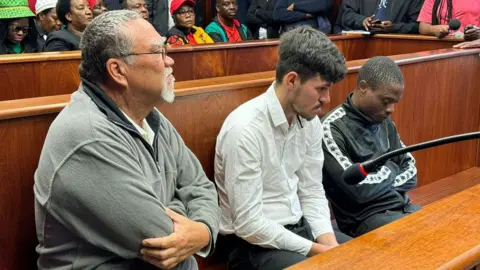
A shocking case in South Africa has gripped the nation after a farm worker testified that he was forced by his employer to help dispose of the bodies of two black women by feeding them to pigs. The chilling incident has reignited conversations about racial tensions and violence in the country’s rural communities.
According to testimony before the Polokwane High Court, 21-year-old farm worker Adrian de Wet recounted how his boss, Zachariah Johannes Olivier, allegedly ordered him to throw the bodies of two women Maria Makgato, 45, and Lucia Ndlovu, 34 into a pig enclosure after they were shot. The women were reportedly on the farm in Limpopo province searching for food when they were attacked.
De Wet, who turned state witness after initially being charged with murder, told the court that his employer instructed him to dispose of the evidence, claiming that “when pigs are hungry enough, they’ll eat anything.” His testimony revealed a disturbing attempt to conceal the crime through horrifying means.
On the night of 17 August 2024, De Wet and Olivier allegedly armed themselves with hunting rifles and waited for trespassers to enter the property. After about 30 minutes, they reportedly heard voices approaching and opened fire, striking one of the women. The following morning, they returned to find her body and threw it into an enclosure containing several adult pigs.
De Wet testified that another body was found roughly 25 meters from the first one the next day. Olivier allegedly instructed him, along with another man, William Musora, to throw this second body into the same pigsty. When they returned several days later, they discovered that the pigs had partially devoured the remains.
Photographs presented in court showed severe mutilation to the victims’ bodies, including missing flesh on the buttocks, thighs, face, and shoulders. The gruesome evidence left the courtroom in visible distress—family members of the victims wept openly, while the accused farmer was seen wiping away tears as his former employee gave his account.
De Wet further testified that after the killings, Olivier destroyed the murder weapons by chopping up the hunting rifles with an angle grinder, burning the wooden parts, and disposing of the metal pieces and spent cartridges down a borehole to eliminate evidence.
During questioning, state prosecutor Advocate George Sekhukhune asked De Wet why they placed the bodies inside the pig enclosure. “We were disposing of the evidence because when pigs are hungry enough, they’ll eat anything,” he replied grimly.
The case has sparked nationwide outrage, reigniting discussions about racism, inequality, and justice in South Africa’s agricultural sector. Many civil society groups and activists have condemned the brutality of the crime, calling it a reflection of the deep-rooted racial and class divisions that persist nearly three decades after the end of apartheid.
While South Africa is officially a multiracial democracy, rural areas still reflect the structural inequalities of the past—most farmland remains under white ownership, and the majority of farm laborers are black and often underpaid. The murder case has amplified these tensions, highlighting the fragile coexistence between landowners and workers in the country’s agricultural heartland.
Both Zachariah Johannes Olivier, 60, and William Musora, 50, are facing charges of murder, obstruction of justice, and unlawful possession of firearms. Their trial continues, with cross-examinations of the defense scheduled to resume next week.
For many South Africans, the gruesome details of this case serve as a painful reminder of the violence, exploitation, and racial trauma that continue to plague rural communities issues that demand urgent attention and justice for the victims whose lives were so brutally taken.










Leave a comment