


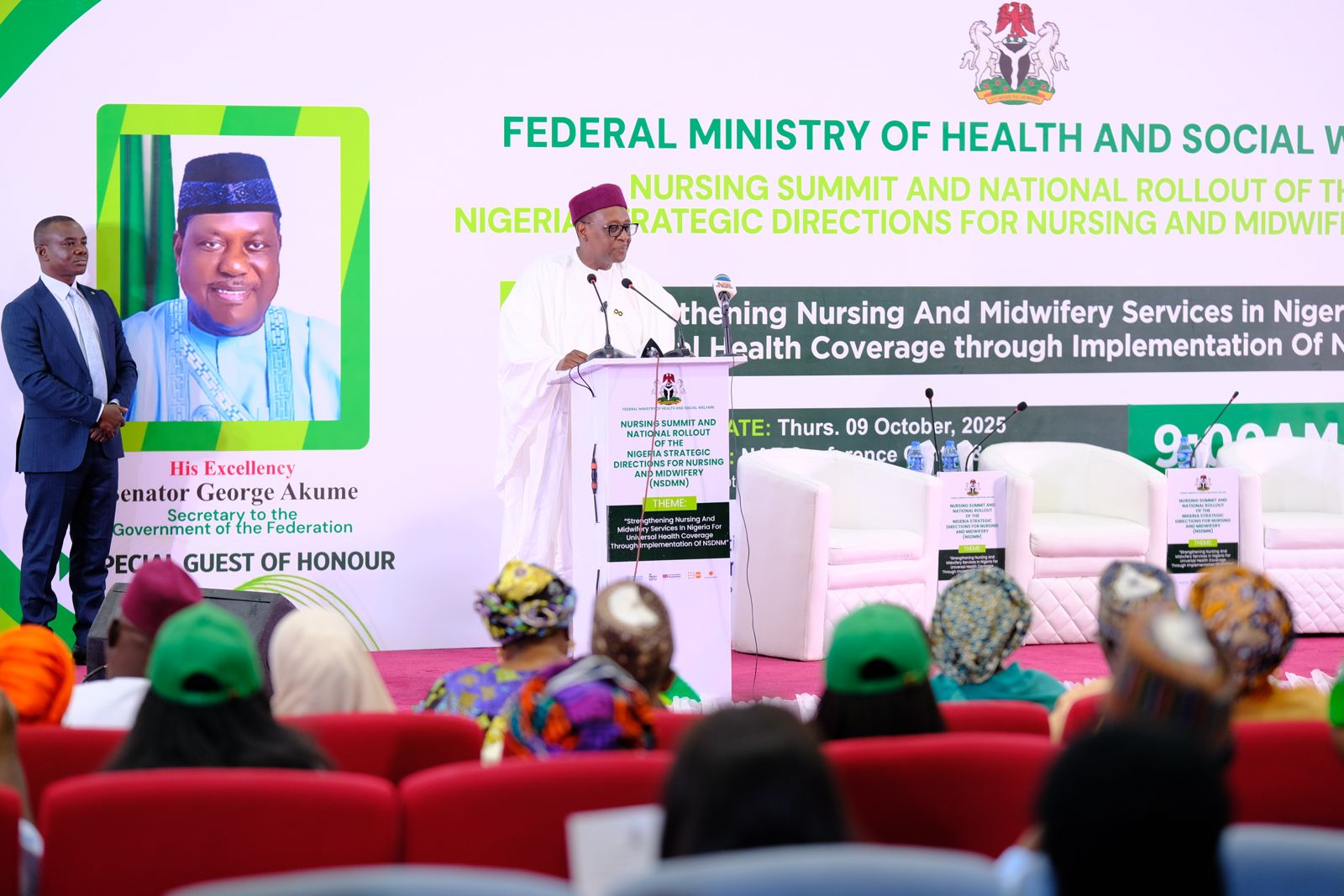
The Federal Government of Nigeria has taken a historic step toward transforming the country’s healthcare system with the official launch of the Nigeria Strategic Directions for Nursing and Midwifery (NSDNM) 2025–2030, a comprehensive reform blueprint aimed at strengthening education, workforce development, leadership, and service delivery within the nursing and midwifery professions.
Speaking at the National Nursing Summit and official rollout of the NSDNM in Abuja, the Coordinating Minister of Health and Social Welfare, Professor Muhammad Ali Pate, CON, described the initiative as a “blueprint for transformation” that will reposition Nigeria’s nursing and midwifery services for quality, equity, and global competitiveness. Prof. Pate emphasized that nurses and midwives form the foundation of the health system, noting that the strategy is not just another policy document but a practical framework for reform, innovation, and investment in human capital.
Under President Bola Ahmed Tinubu’s administration, Nigeria has witnessed an unprecedented expansion of health sector investments. Prof. Pate announced that the enrolment quota for nursing and midwifery training institutions has surged from 28,000 in May 2023 to 115,000 for the 2025 academic year. According to him, this fourfold increase represents a bold step toward addressing both national and global shortages in skilled health workers, particularly nurses, midwives, pharmacists, and laboratory scientists. He added that beyond expanding the workforce, the government remains committed to improving working conditions and creating an enabling environment where healthcare professionals can thrive.
Prof. Pate also highlighted the administration’s Health Sector Renewal Investment Initiative, through which over 69,000 frontline health workers across Nigeria’s 36 states have already been retrained under a coordinated reform agenda known as the Sector-Wide Approach. Nurses and midwives make up a significant portion of those who have benefited from this national upskilling drive. In addition, the Federal Government has approved recruitment waivers for 20,000 new health workers—60 percent of whom will be nurses and midwives—to fill critical workforce gaps in federal health institutions.
The Minister credited the World Health Organization (WHO) for providing technical and financial support in developing the NSDNM, noting that Nigeria’s new strategy aligns with the WHO Global Strategic Directions for Nursing and Midwifery (2021–2027). This alignment, he said, underscores Nigeria’s commitment to adopting international best practices and elevating professional standards within the healthcare workforce.
In what marks another milestone achievement, Nigeria has become the first country in West Africa to implement the Best Practice Spotlight Organization (BPSO) model in partnership with the Registered Nurses Association of Ontario. The initiative, which promotes evidence-based nursing practices, aims to improve maternal and neonatal health outcomes and strengthen the overall quality of care in hospitals and community health centers. “We are proud to pioneer this model in the region,” Prof. Pate stated. “It demonstrates our determination to build a competent, motivated, and technology-driven nursing and midwifery workforce capable of meeting the health needs of Nigerians and contributing to global health goals.”
The Minister reaffirmed President Tinubu’s unwavering support for the healthcare sector, recalling his appointment by the African Union in 2024 as the Champion for Human Resources for Health and Community Health Delivery Partnership. He noted that this continental recognition reinforces the President’s commitment to human capital development and his vision to make Nigeria a leader in health workforce transformation across Africa.
Also speaking at the event, the Permanent Secretary of the Federal Ministry of Health and Social Welfare, Daju Kachollom, mni, announced the inauguration of a Technical Working Group (TWG) to oversee the implementation of the NSDNM. She described the development as a critical transition from planning to action, charging members of the TWG to drive measurable progress through data-driven decision-making, innovation, and collaboration across federal and state institutions. “You are not here to re-discuss the strategy,” she told the group. “Your task is to translate it into tangible outcomes that will transform lives and strengthen our health system.”
In his keynote remarks, Professor Saleh Ngaski Garba, Head of Nursing Science at Bayero University, Kano, underscored that nurses and midwives represent nearly 60 percent of Nigeria’s health workforce and are indispensable in achieving the Sustainable Development Goals (SDGs) and Universal Health Coverage (UHC). He urged government and development partners to sustain investment in the profession, stressing that strategic retention measures are crucial to bridging existing workforce gaps.
Delivering a goodwill message on behalf of the WHO Country Representative, Mary Brentrow applauded Nigeria’s leadership for taking bold and strategic steps to address the critical shortage of nurses and midwives. She noted that investing in nursing and midwifery is not merely an expenditure but a strategic investment in public health resilience, gender equity, and economic development.
Prof. Pate concluded his address by calling for unified national action to ensure the successful implementation of the NSDNM 2025–2030, emphasizing that the Ministry alone cannot achieve the desired transformation. He appealed to state governments, professional bodies, training institutions, and development partners to align with the national mission to build a stronger, more resilient, and people-centered healthcare system.
With the rollout of this strategic blueprint, Nigeria has set a new benchmark for health workforce planning and development in Africa. The Tinubu administration’s expansion of nursing school enrolment from 28,000 to 115,000 marks a landmark reform that will redefine healthcare delivery, create employment opportunities, and enhance the country’s capacity to achieve universal health coverage by 2030.










Leave a comment