


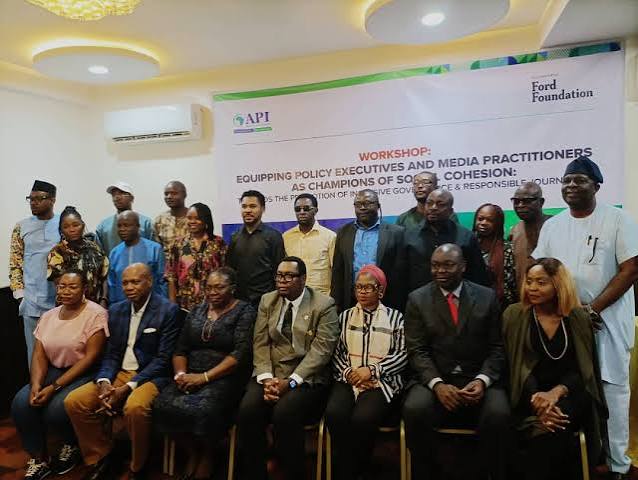
The Africa Polling Institute, with support from the Ford Foundation, has concluded a four-day capacity-building workshop in Abuja to equip Nigerian policy executives and media practitioners with the tools, knowledge, and frameworks needed to champion social cohesion in their respective fields. The workshop, held from 15 to 18 June 2026 at Treasure Suites and Apartments, brought together stakeholders from government, civil society, academia, and the media around a shared conviction: that building a more unified Nigeria requires deliberate, data-informed action from those who shape policy and those who shape public narrative.
The training was structured in two distinct sessions. The first, running from 15 to 16 June, was tailored for policy executives, focusing on how to more effectively integrate social cohesion research and public sentiment data into governance and decision-making. The second session, held on 17 and 18 June, was designed specifically for media practitioners under the theme “Equipping Media Practitioners as Champions of Social Cohesion Towards the Promotion of Responsible Journalism.” Together, the two sessions addressed what the Africa Polling Institute has identified as a significant and underappreciated gap: the disconnect between the social cohesion data that researchers produce and the capacity of policymakers and journalists to translate that data into action and communication that actually serve the public.
For the media cohort, the curriculum was both conceptually grounded and practically oriented. Participants worked through a six-module programme covering the core indicators of social cohesion: national identity, trust and confidence in institutions, social justice, equity and inclusion, civic participation, and future expectations. These are not abstract categories. They are the building blocks of a functioning society, and understanding how to measure, interpret, and communicate them is a skill with direct consequences for how Nigerians understand their country and each other. Alongside the conceptual training, participants received hands-on instruction in basic data analytics techniques using real-world national datasets, equipping them to strengthen evidence-based reporting and move beyond anecdote-driven public discourse.
The facilitator lineup was impressive in both academic standing and practical experience. Dr. Olusoji Adeniyi, Prof. Bell Ihua, Odoh Diego Okenyodo, Dr. Helen Emore, Dr. Obiora Chukwumba, and Ismail Abdulaziz led participants through interactive sessions, case studies, group activities, and practical exercises that put theory directly in service of professional application. The approach reflected a deliberate design philosophy: that training of this kind only produces lasting change when participants leave with skills they can use the following week, not just concepts they can discuss at conferences.
Among the media organisations represented at the workshop was Africa ScoreCard, whose participation underscores the platform’s ongoing commitment to developmental journalism and the kind of responsible, evidence-driven reporting that contributes to national progress rather than simply documenting its absence.
The rationale behind an initiative of this kind is worth pausing on. Nigeria is a country of extraordinary complexity: 200 million people, hundreds of ethnic groups, a deeply contested political history, and a media landscape that at its worst amplifies division and at its best builds bridges. The role that journalists and policymakers play in determining which of those outcomes prevails is enormous, and largely underestimated. When a journalist frames a story about inter-communal tension, the choices made about language, sourcing, and context carry consequences that extend far beyond the news cycle. When a policymaker interprets public sentiment data, the quality of that interpretation shapes the decisions that affect millions of lives. The Africa Polling Institute’s workshop is built on the understanding that those choices and interpretations improve when the people making them are better trained.
The workshop concluded with a networking reception that gave participants and facilitators the opportunity to build relationships beyond the formal training environment, exchange ideas across institutional lines, and begin exploring the collaborations that the next phase of this work will require. Certificates of Participation were presented to all attendees in recognition of their engagement and commitment.
As Nigeria continues to navigate the social, economic, and political pressures that define this moment in its history, the Africa Polling Institute and the Ford Foundation have made a quiet but meaningful investment in the people who will help determine how that navigation goes. Not through grand gestures, but through four days in Abuja, a rigorous curriculum, and a room full of professionals who left better equipped to do work that matters.





Leave a comment