


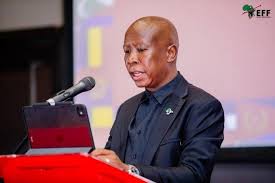
South African opposition leader Julius Malema has waded into the growing diplomatic row over Ghana’s decision to evacuate hundreds of its citizens from South Africa, arguing that Accra’s swift response was unnecessary, poorly timed, and ultimately counterproductive to the goal of de-escalating tensions on the ground.
Speaking to the media, the Economic Freedom Fighters leader questioned the judgement behind Ghana’s move, suggesting it had done more to inflame the situation than to resolve it. “The Ghana response was not necessary at that moment,” he said. “It creates a perception that we are all like that.” His concern, plainly stated, is that a formal government evacuation sends a signal to the world that South Africa is uniformly hostile to African migrants, a characterisation he clearly rejects.
Malema argued that Ghana should have given South African authorities more room to handle the situation through internal dialogue and law enforcement before escalating to repatriation flights. “We don’t think Ghana responded in a manner that really enforces dialogue and diplomatic engagement,” he said. “It actually creates a very bad, extreme situation.” He also urged legally documented Ghanaian migrants who feel unsafe to seek protection from the police and other security agencies rather than boarding flights home.
His comments arrive in the middle of an already charged moment. Roughly 300 Ghanaian nationals gathered at Johannesburg’s OR Tambo International Airport on 27 May to board one of the first repatriation flights back to Accra, a group that included women and children. Ghana’s High Commissioner to South Africa, Benjamin Quashie, confirmed that 826 Ghanaians had registered to return home. Ghana’s Foreign Affairs Minister Samuel Okudzeto Ablakwa has signalled that additional evacuation flights are expected in the coming week, meaning the departures are far from over.
The repatriation effort was set in motion by a wave of protests organised by the group March and March, which has been active in parts of Gauteng, KwaZulu-Natal, and the Eastern Cape. The group has issued a deadline demanding that undocumented foreign nationals leave South Africa by the end of June. Some Ghanaian nationals have reported violent attacks and intimidation during the protests, accounts that local media have covered and that have understandably alarmed both the affected community and the Ghanaian government watching from Accra.
Malema’s position is not without internal logic. There is a legitimate argument that high-profile evacuations, however well-intentioned, can harden narratives on all sides, giving anti-immigrant activists the impression that their pressure is working while simultaneously feeding international headlines that paint South Africa as an unsafe country for African migrants. He is also not wrong that dialogue and law enforcement are the more durable long-term tools for addressing the root causes of xenophobic tension.
But that argument is considerably harder to make to a Ghanaian mother in Johannesburg who has witnessed violence in her neighbourhood and been told by her own government that a flight home is available. For Ghana, the calculus was simpler: citizens were scared, attacks had been reported, and the government had both the means and the mandate to act. Waiting for South African authorities to resolve the situation through dialogue, in a country with a long and painful history of xenophobic outbreaks, was a risk Accra chose not to take.
South Africa’s repeated cycles of anti-immigrant violence, which have targeted migrants from across the continent for decades, are the uncomfortable context that no amount of diplomatic framing can fully erase. Malema is right that not all South Africans are xenophobic. He is also right that dialogue matters. But the reason Ghana felt compelled to act so quickly is written in that same history, and dismissing the evacuation as unnecessary does not address why hundreds of people were standing at an airport, ready to leave, in the first place.










Leave a comment