


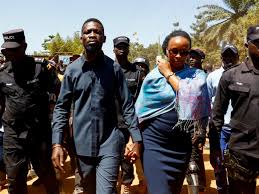
Uganda’s political tensions have escalated sharply following a police raid on the home of opposition leader Bobi Wine, forcing the singer turned politician into hiding and raising fresh concerns about political repression after the country’s disputed presidential election. Wine, whose real name is Robert Kyagulanyi, says he narrowly escaped the raid and has since been moving constantly to avoid arrest, relying on what he describes as protection from ordinary citizens.
Speaking from an undisclosed location, Bobi Wine said he is being sheltered by supporters across the country and remains on the move to evade security forces. He also claimed that his wife and other close relatives have been placed under house arrest, a move he described as collective punishment aimed at intimidating him and weakening the opposition. Authorities have not publicly confirmed the status of his family, but the allegations have intensified criticism of the government’s conduct since the election.
Bobi Wine was the main challenger to President Yoweri Museveni in last week’s presidential vote. Official results declared Museveni the winner with about 72 percent of the vote, while Wine was credited with just under 25 percent. Wine has rejected the outcome, describing the election as a blatant theft and accusing the authorities of widespread intimidation, vote manipulation, and violence against his supporters.
Asked about the future direction of his National Unity Platform party, Wine told AFP that rigid planning was impossible under the current conditions. He said that in a dictatorship, political actors do not develop fixed strategies but are instead forced to react to the nature and intensity of oppression. His remarks reflect the uncertainty now facing Uganda’s opposition as arrests, raids, and threats continue in the aftermath of the vote.
The situation worsened further after Uganda’s army chief, Muhoozi Kainerugaba, who is also President Museveni’s son, issued explicit threats against Wine. In a series of public statements, Kainerugaba said security forces had killed what he described as terrorists linked to the National Unity Platform and openly stated that he was praying for Bobi Wine to be the next to die. The comments triggered outrage among opposition figures, human rights organisations, and international observers, who warned that such rhetoric could incite violence and undermine the rule of law.
Responding to the threats, Bobi Wine rejected the accusations and defended his political role. He said he was not a criminal but a presidential candidate, adding that running against the president was not a crime. He accused the government of using the language of terrorism to delegitimise political opposition and justify harsh crackdowns.
President Museveni and senior officials have repeatedly labelled the opposition as terrorists and accused them of attempting to use violence to overturn the election results. The government has defended its actions as necessary to maintain stability and prevent unrest. However, last week’s vote was marred by reports of violence, arrests, and an internet shutdown that restricted communication across the country. African election observers said the climate of fear created by arrests and abductions had seriously undermined the credibility of the process.
Uganda’s political crisis highlights long standing concerns about democratic space in a country that has been ruled by the same leader for decades. Bobi Wine’s rise has galvanised young voters and urban populations frustrated by unemployment, corruption, and limited political freedoms. His current situation, forced into hiding while facing threats from the highest levels of the security establishment, has become a powerful symbol of the risks faced by opposition figures in the country.
As tensions remain high, the coming days will be critical in determining whether Uganda moves toward dialogue and de escalation or deeper repression. For now, Bobi Wine’s flight from his own home underscores the fragile state of political freedoms and the uncertain future of opposition politics in the country.







Leave a comment