


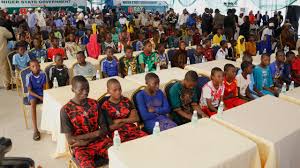
The return of one hundred schoolchildren abducted last month from St. Mary’s Catholic School in Papiri has brought emotional reunions and a measure of relief to families who spent nearly three weeks in anguish. Yet the homecoming is painfully incomplete. More than one hundred fifty other students and teachers remain in captivity, deepening the sense of uncertainty that hangs over the community.
The attack on November twenty one, one of the largest school kidnappings in Nigeria since the Chibok abductions, saw at least three hundred three children and twelve teachers seized by armed men. About fifty children managed to escape shortly after the assault, but the majority were driven deep into the forest by the gunmen. Authorities have given no details about how the weekend release was secured, and it remains unclear whether a ransom was paid.
For those who returned, the ordeal leaves deep scars. Among the freed is Onyeka Chieme, who described the inhumane conditions inside the kidnappers’ camp.
Speaking about the conditions, he recounted how drinking water came from the same river where the kidnappers’ families washed clothes, fed animals and carried out daily chores. The water was all the captives had to drink.
His father, Anthony Chieme, expressed gratitude for his son’s return but remains desperate for news of his other child who is still among the missing. He urged authorities to work toward freeing every remaining captive, stressing that families across Papiri are united in the same painful wait.
Local residents believe the attack was carried out by armed criminal gangs that have terrorised communities across Nigeria’s northwest and central regions. These gangs are notorious for kidnapping schoolchildren and travellers for ransom, part of a growing pattern of insecurity that has claimed thousands of victims in recent years.
Despite the trauma, some parents remain determined to restore stability and ensure their children continue their education. One mother, Precious Njikonye, said she would send her children back to school because she refuses to let fear dictate their future. Her words reflect a resilience shared by many in the community.
In Papiri, daily life is slowly resuming. Residents walk dusty streets, and motorbikes are cleaned and repaired as if trying to reclaim normalcy. Yet beneath this routine is a community still gripped by the absence of the children who have not returned.
According to the Associated Press, at least one thousand seven hundred ninety nine students have been kidnapped across Nigeria in the past decade, highlighting the scale of the crisis.
For now, Papiri’s joy is restrained by one overriding plea to the government: to bring every remaining child home safely and end a nightmare that has gone on far too long.










Leave a comment