


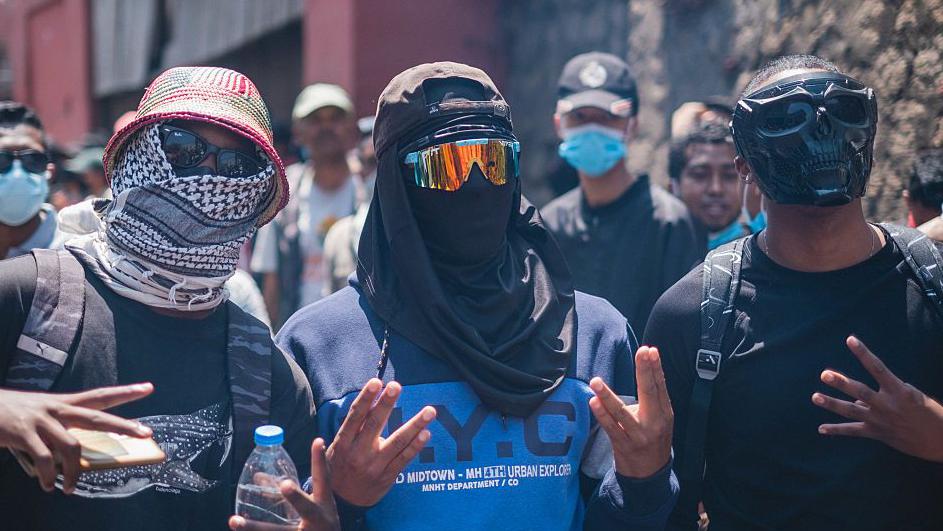
Madagascar has been plunged into its largest wave of unrest in more than 15 years, as tens of thousands of people take to the streets across the island nation in a show of defiance against President Andry Rajoelina’s government. What began as anger over crippling shortages of electricity and water has spiraled into a nationwide protest movement demanding political change, accountability, and the president’s resignation.
The demonstrations, led initially by a youth-driven online movement known as Gen Z Mada, have rapidly gained momentum since the arrest of two local politicians on 19 September. They had planned to stage a peaceful march in the capital, Antananarivo, to protest constant power and water cuts caused by the state-owned utility Jirama. Their detention was widely perceived as an attempt to silence dissent and instead ignited public fury. Within days, crowds swelled across the capital and spread to at least eight other cities, transforming what began as local anger into a nationwide crisis.
The United Nations estimates that at least 22 people have been killed and more than 100 others injured during the unrest, though the Malagasy government disputes those figures and claims they are based on “rumours and misinformation.” Security forces have responded with tear gas, water cannons, and mass arrests, while a dusk-to-dawn curfew was imposed in Antananarivo following incidents of looting and the burning of government offices, including the Ministry of Finance.
Despite President Rajoelina’s move to dissolve his government on Monday, the protests have only intensified, with demonstrators waving banners declaring “Rajoelina out.” Activists accuse the government of corruption, mismanagement, and indifference to the daily struggles of ordinary citizens, who face soaring unemployment, food insecurity, and deteriorating living conditions. According to the World Bank, three-quarters of Madagascar’s 30 million citizens live below the poverty line, and only one in three has access to electricity.
Civil society groups, labour unions, and opposition leaders have rallied behind the protests. The country’s largest labour federation, the Malagasy Trade Union Solidarity, joined the movement, while former President Marc Ravalomanana and opposition leader Siteny Randrianasoloniaiko issued a joint statement supporting demonstrators and rejecting any offers to enter Rajoelina’s government, describing such a move as a betrayal of the Malagasy people. Churches and civil society groups have called for national dialogue to prevent the country from sliding into deeper instability.
The president, who returned to power in 2018 and was controversially re-elected in 2023 in polls boycotted by the opposition, has attempted to calm tensions by promising World Bank-backed projects to stabilize electricity supply and pledging compensation for businesses affected by looting. But his calls for patience have largely fallen on deaf ears. Many young people, struggling with insecure jobs and rising costs of living, see Rajoelina as directly responsible for the nation’s woes.
Analysts warn that the crisis could deepen if authorities continue to rely on repression instead of dialogue. Human rights advocates caution that prolonged crackdowns may worsen political fragmentation, fuel nationalist sentiment against perceived foreign interference, and spark long-term economic damage. The military’s stance is seen as a critical factor: if security forces refuse to enforce heavy crackdowns, Rajoelina’s hold on power could weaken significantly.
Madagascar has a turbulent history of political uprisings since independence in 1960, with coups and mass demonstrations repeatedly altering the country’s leadership. The most dramatic occurred in 2009, when protests forced then-President Ravalomanana to step down and brought Rajoelina, then a young former mayor of Antananarivo, to power for the first time.
Today, history appears to be repeating itself. The youth-led Gen Z Mada movement, amplified through social media platforms like Facebook and TikTok, has united frustrated citizens across generations, sparking a nationwide call for change. With growing deaths, arrests, and public anger, the country faces a dangerous crossroads: either a negotiated path to reform and stability, or the risk of prolonged unrest that could push Madagascar deeper into crisis.





Leave a comment