

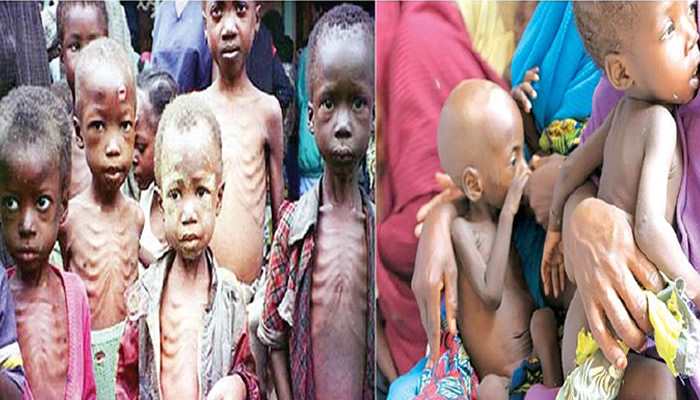
In Maiduguri, the capital of Nigeria’s troubled Borno State, 30-year-old Zara Ali clutched her frail two-year-old daughter Amina outside a crowded government hospital, hoping yet again for a breakthrough in her child’s treatment. Displaced from their home in Damboa by Boko Haram’s long-running insurgency, Ali has been struggling for years to keep her daughter healthy. Amina’s patchy, brownish hair and weakened frame are the visible scars of prolonged malnutrition, a crisis that has trapped millions of children across northeast and northwest Nigeria.
Despite months of treatment with a protein-rich, ready-to-eat paste, Amina’s recovery has been slow. “She gets sick, gets a little better, and then falls ill again,” Ali said, her voice a mix of exhaustion and frustration. But now, her fight is becoming even harder. Many of the free aid clinics that provided life-saving nutrition supplements are scaling back operations or closing entirely. “Honestly, their interventions were really helpful, and we need them to come back and help our children,” she pleaded.
Amina is one of an estimated five million children in the region suffering from acute malnutrition, in what aid agencies describe as Nigeria’s most severe hunger crisis in recent memory. In the northeast, Boko Haram’s insurgency has devastated livelihoods for more than a decade, displacing over 2 million people and killing more than 35,000. In the northwest, bandit groups are driving similar destruction, making it nearly impossible for families to farm or trade.
This year, the situation has worsened dramatically due to massive funding cuts to global aid programmes. The United States, historically one of the largest donors, slashed its contributions to humanitarian aid by roughly 75 percent since February. The impact has been immediate and devastating.
The United Nations World Food Programme (WFP), the largest food aid provider in the world, was forced to close more than half of its nutrition clinics across northeast Nigeria in August. Emmanuel Bigenimana, head of WFP operations in the region, said that over 300,000 children have now been cut off from critical nutrition supplements. By July, WFP had already distributed its last grain reserves for displaced adults and families, leaving warehouses nearly empty. “For Nigeria, which is in the lean season before harvest, there is no more food,” Bigenimana warned, as sacks of grain were loaded onto trucks bound for Chad, another nation in crisis.
Once considered one of Nigeria’s agricultural breadbaskets, northeast Nigeria’s fertile savannah lands should be producing abundant nuts, grains, and vegetables. But years of violence, coupled with climate shocks, have crippled food production. Boko Haram and its splinter factions still control some territory, making farming outside of secured urban areas nearly impossible. Since 2019, the Nigerian military has been forced to concentrate in heavily fortified garrison towns to prevent troop losses, leaving surrounding farmland exposed to armed attacks. “Those who venture outside the towns risk being targeted by armed fighters,” explained security analyst Kabir Adamu.
For displaced families like Zara Ali’s, survival now depends on a fragile combination of overstretched hospitals, dwindling aid supplies, and the hope that security conditions will improve enough to allow farming to resume. But as conflict persists and humanitarian resources dry up, millions of Nigerian children remain on the edge of starvation victims of a crisis where war, hunger, and funding cuts collide.






Leave a comment