


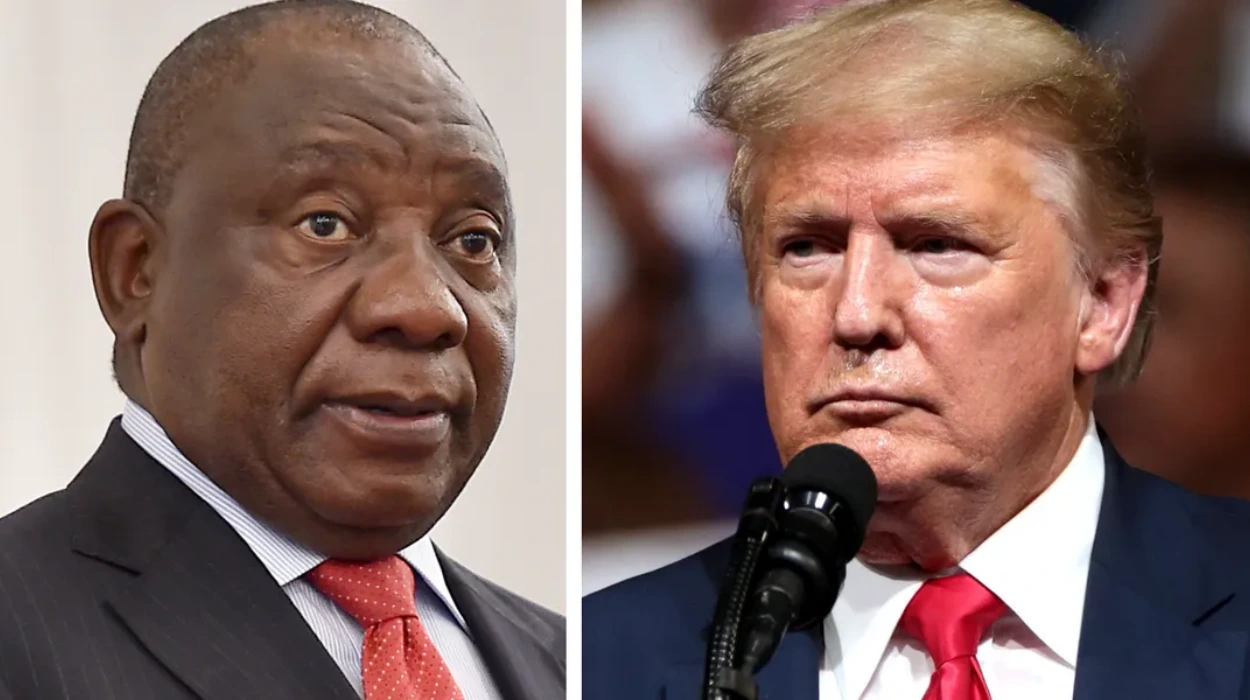
The United States House Foreign Affairs Committee has advanced controversial legislation that could redefine the longstanding bilateral relationship between the U.S. and South Africa, in response to Pretoria’s recent foreign policy moves, particularly its genocide case against Israel at the United Nations’ International Court of Justice (ICJ). The bill, which was approved in a 34-16 vote, signals growing frustration within the U.S. Congress, particularly among Republicans, over South Africa’s perceived pivot away from the West.
Sponsored by Republican Congressman Ronny Jackson of Texas, the bill directs a comprehensive review of U.S.-South Africa relations and calls for a detailed assessment of whether any South African officials or members of the African National Congress (ANC) the ruling party since the end of apartheid in 1994, should be sanctioned under American anti-corruption laws. The legislation aligns with the Trump administration’s more confrontational approach toward countries seen as unfriendly to U.S. interests and allies.
Jackson stated bluntly that “South Africa has abandoned America and our allies and increasingly aligned itself with our adversaries,” referencing its growing ties with global powers like China and Russia, and its legal challenge to Israel’s military operations in Gaza. South Africa’s decision to file the case at the ICJ accusing Israel of genocide has drawn severe criticism from pro-Israel U.S. lawmakers, who see the move as an aggressive affront to American and Israeli interests.
However, Democrats have pushed back sharply on the bill, arguing that it could undermine efforts to engage South Africa diplomatically and may further alienate a key partner on the African continent. Ranking Committee Member Rep. Gregory Meeks (D-N.Y.) labeled the bill as politically motivated and hypocritical. He pointed out the omission of historical U.S. support for apartheid-era South Africa, including Washington’s refusal to impose sanctions during a time of systemic racial oppression.
Democrats also criticized what they view as a double standard in the U.S. refugee policy, citing the Trump-era decision to grant blanket refugee status to white Afrikaners from South Africa, who represent about 7% of the population but still control roughly 75% of the country’s farmland. “We are welcoming white South Africans who often do not need or request refugee status, while simultaneously rejecting asylum-seekers from Haiti, Venezuela, Afghanistan, and other war-torn nations,” Meeks argued.
He also referenced an Oval Office incident during the Trump presidency, where then-President Trump made baseless claims about the mass murder of white farmers in South Africa, further straining relations between the two countries. That narrative was widely discredited but played into racialized fears and political narratives within the U.S.
Despite the contentious nature of the bill, the broader session saw bipartisan support for several other international cooperation measures, including one aimed at enhancing legislative partnerships between South Korea, Japan, and the United States. But the South Africa legislation remains a flashpoint, illustrating the deepening divide over how Washington should engage with global South countries that are pursuing more independent or nonaligned foreign policies.
As the legislation moves forward, the Biden administration will be under increased pressure to clarify its stance. While the White House has expressed concern over South Africa’s ICJ case, it has not publicly supported imposing sanctions or punitive reviews.
The evolving situation raises complex questions about the future of U.S.-Africa relations, the role of historical memory in shaping foreign policy, and how superpowers navigate a multipolar world where countries like South Africa assert more autonomous roles on the global stage.










Leave a comment