


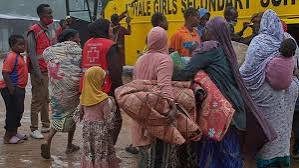
Thousands of Ethiopians who fled deadly clashes in their home country are awaiting registration and humanitarian assistance in Kenya after crossing the border in search of safety, as authorities and international agencies work to respond to the growing displacement crisis.
The arrivals followed renewed fighting between communities in Ethiopia’s Oromia and Somali regional states, which share administrative boundaries around the border town of Moyale.
According to the United Nations High Commissioner for Refugees (UNHCR), an estimated 50,000 people had crossed into Kenya by October 29, although the figure remained subject to verification as more displaced people continued to arrive.
Many of the arrivals were waiting to be processed at Al-Huda Primary School in Moyale, where authorities were conducting registration and verification exercises.
The displaced people have received temporary international protection status from UNHCR while awaiting further processing.
The latest influx represents a sharp increase from the approximately 36,000 people recorded on October 27, highlighting the rapid escalation of the humanitarian situation along the Kenya-Ethiopia border.
The violence reportedly began on October 20 after a Somali regional flag was raised on the Ethiopian side of Moyale, a town jointly administered by the Oromia and Somali regional authorities. The incident triggered tensions between the two communities, with clashes subsequently involving regional security forces and local militias.
Several people have reportedly been killed in the fighting, although the full casualty figures remain unclear.
Many of those fleeing are women and children. Some have found shelter with relatives and host communities in Kenya, while others are staying in temporary accommodation, including schools and churches.
Fatima Mohammed-Cole, UNHCR’s representative in Kenya, said the situation remained fluid, with further cross-border movements possible as tensions persisted in the affected areas.
She identified food as the most urgent humanitarian need, alongside access to safe drinking water, emergency shelter, sanitation and healthcare.
Humanitarian agencies scale up response
UNHCR has deployed an emergency team to Moyale and is working with the Kenyan government, the Department of Refugee Services, county authorities and humanitarian organisations to coordinate assistance.
Partners involved in the response include the International Organization for Migration (IOM), UNICEF, the World Food Programme (WFP) and the Kenya Red Cross Society.
The agencies are mobilising emergency supplies, including essential household items and temporary shelter materials, to support nearly 12,000 people, while further assessments are being conducted to establish the needs of displaced families.
UNHCR, IOM, UNICEF and WFP are also seeking $8.9 million to provide humanitarian assistance to up to 50,000 people over three months. The proposed intervention covers food, shelter, water, sanitation, registration and protection services, particularly for children and other vulnerable groups.
The International Organization for Migration has separately indicated that Kenya and its humanitarian partners are preparing for a response that could accommodate up to 80,000 displaced people if arrivals increase.
Pressure on host communities
The growing number of arrivals has raised concerns among authorities in Kenya’s Marsabit County, where local communities are already experiencing shortages of food and water.
Local leaders have appealed for additional humanitarian support, warning that the influx could place further pressure on public services and resources in the border region.
Kenyan residents have also opened their homes to displaced families, providing temporary accommodation, food and other essential assistance.
Although fighting appeared to ease towards the end of October, sporadic gunfire continued to be reported across the border, while security concerns remained in Moyale.
The latest displacement adds to Ethiopia’s wider humanitarian challenges, as several parts of the country continue to experience insecurity and conflict.
Humanitarian agencies have called for sustained support to ensure that displaced people receive adequate protection and essential services while efforts continue to address their immediate needs.









Leave a comment