


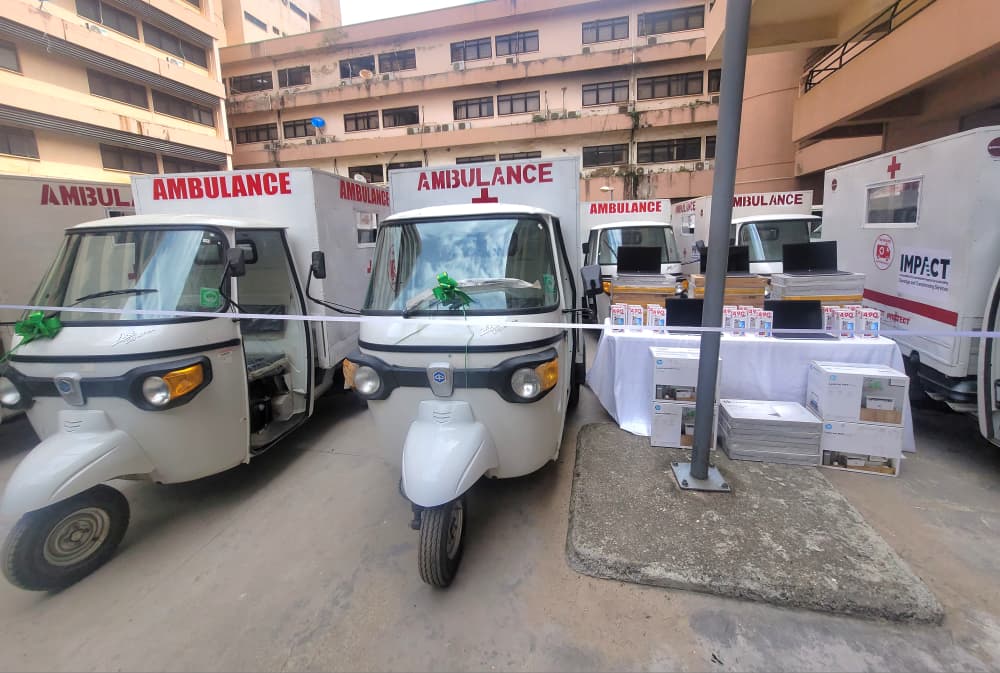
President Bola Ahmed Tinubu on Friday, 29 May 2026, marked the third anniversary of his administration with the launch of a sweeping set of health infrastructure projects spanning every geopolitical zone in the country, alongside a fleet of 145 tricycle ambulances designed to bring emergency medical services to communities that have long been left out of the country’s formal healthcare system.
Speaking virtually during the nationwide commissioning ceremony, President Tinubu framed the moment as a turning point in Nigeria’s long-overdue healthcare renewal. “We are determined to give Nigerians the kind of care that, for too long, only those who could travel abroad enjoyed,” he said. “From rural Sokoto to the Delta creeks and the streets of Lagos, our emergency response system must work as one national structure.” It is a vision that acknowledges, plainly, the historic failure of the Nigerian state to provide equitable healthcare across its vast and varied geography, and makes the case that this administration intends to change that.
The infrastructure projects commissioned on Friday span primary, secondary, and tertiary healthcare institutions across the country. Among the facilities launched are Emergency Operations Centres in Kano, Sokoto, and Katsina states; a Lagos Vaccine Hub; primary healthcare infrastructure in Delta State; and a series of major upgrades at federal teaching hospitals and medical centres. These include a Trauma Centre at Ahmadu Bello University Teaching Hospital in Zaria, a Mental Health Complex at the University of Maiduguri Teaching Hospital, an Infertility and Assisted Reproductive Technology Centre in Bauchi, a Laboratory Complex at the University of Uyo Teaching Hospital, and the President Bola Ahmed Tinubu Complex at the Federal Medical Centre in Abuja.
The 145 tricycle ambulances form part of a broader National Emergency Medical Service and Ambulance System, known as NEMSAS, which also includes six boat ambulances and emergency communication and dispatch equipment. The inclusion of boat ambulances is significant, addressing the particular challenge of reaching riverine and coastal communities where road-based emergency services have historically been unable to respond in time. Permanent Secretary Daju Kachollom confirmed that the ambulances will be stationed at primary healthcare centres in rural areas, with trained drivers and nurses accompanying every deployment to ensure that the vehicles are operated to full clinical effect.
The Coordinating Minister of Health and Social Welfare, Professor Muhammad Ali Pate, placed the day’s events within the framework of Nigeria’s broader health reform agenda, describing the projects as measurable steps toward achieving Universal Health Coverage by 2030 under the Nigeria Health Sector Renewal Investment Initiative. He emphasised that the administration’s approach has been deliberate in combining physical infrastructure expansion with improvements to prevention, immunisation, maternal care, and the quality of primary healthcare systems across the country.
Minister of State for Health Dr Iziaq Adekunle Salako offered some of the most striking headline figures of the event. He revealed that the Federal Ministry of Health and its agencies had lined up over 100 projects to mark the third anniversary, selecting a representative spread across all six geopolitical zones for presidential commissioning. He also disclosed that health insurance coverage has been expanded by more than 33 percent under the current administration, that over 4,000 primary health centres have been revitalised, and that 15 new federal tertiary health institutions have been established. More than 500 high-impact specialist health facilities, including cancer centres of excellence and diagnostic centres, have been provided as part of a deliberate effort to reverse the flow of medical tourism out of the country.
The ambition behind that last point deserves particular attention. Nigeria loses significant foreign exchange and, more importantly, lives, every year to a culture of medical tourism in which those with means travel abroad for treatment that should be available at home. Every cancer centre built, every diagnostic facility opened, every trauma centre staffed represents a direct challenge to that dynamic, and a statement that the standard of care available in Nigeria does not have to be inferior to what is available elsewhere.
Partners who supported the execution of the projects include the World Bank, the Gates Foundation, eHealth Africa, state governments, and federal teaching hospitals. Their involvement reflects the scale of coordination required to deliver infrastructure of this breadth across a country of Nigeria’s size and complexity, and underscores the importance of sustained multilateral and civil society engagement in the long-term task of health system reform.
Three years in, and with a long road still ahead, Friday’s commissioning represents the current administration’s most visible statement yet of what it intends the Nigerian healthcare system to look like by the end of its tenure. The projects are real, the facilities are built, and the ambulances are ready to roll. The test, as always, will be in the sustained operation, maintenance, and staffing of everything that was launched today, in the months and years when the cameras have moved on and the work becomes ordinary.








Leave a comment