



The Federal Government of Nigeria has expressed concern over evolving dynamics in global health funding, emphasizing that Nigeria must take primary responsibility for the health of its citizens.
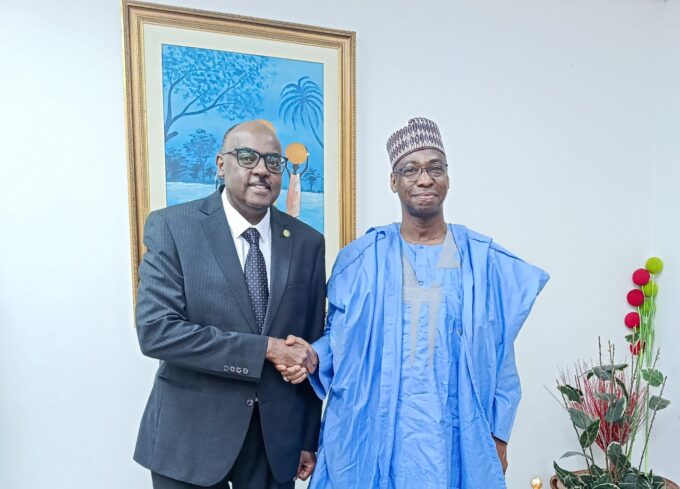
This position was articulated by Iziaq Adekunle Salako, Minister of State for Health and Social Welfare, during a courtesy visit by the Ambassador of Spain to Nigeria, Felix Costales Artieda, who led a delegation to brief the government on ongoing health programmes supported by the Spanish Agency for International Development Cooperation.
Speaking during the meeting, Dr. Salako acknowledged that changes in global health financing present legitimate concerns. However, he stressed that Nigeria must not rely excessively on international donors for the wellbeing of its population.
According to him, while global support remains important, the Nigerian government must remain firmly in control of its health policies, priorities, and financing mechanisms.
He emphasized that the direction of the administration under Bola Ahmed Tinubu is to ensure that Nigeria is firmly in the driver’s seat regarding the health of its citizens, strengthening domestic ownership and sustainability within the sector.
Dr. Salako highlighted that the Federal Government is currently implementing comprehensive reforms through the National Health Sector Renewal Investment Initiative. This transformation agenda is built on four key pillars designed to reposition Nigeria’s healthcare system for efficiency, resilience, and improved service delivery.
He further noted that discussions during the visit reopened opportunities to revisit the 2022 Memorandum of Understanding between Nigeria and Spain, with the aim of operationalizing key provisions, particularly in the area of technology transfer.
Technology transfer, he explained, aligns directly with Nigeria’s broader ambition to unlock the healthcare value chain. This ambition is being driven through the Presidential Initiative for Unlocking the Healthcare Value Chain, which focuses on boosting local manufacturing of medical products and reducing reliance on imports.
Addressing maternal health challenges, Dr. Salako pointed out that Nigeria has taken decisive steps to combat obstetrics fistula and gynecological conditions. The government has established specialized institutions dedicated to obstetrics and gynecology and is providing free treatment and social reintegration support for women affected by obstetric fistula.
He reiterated Nigeria’s commitment to strengthening bilateral collaboration with Spain, assuring the delegation that the Federal Government would actively promote and deepen the partnership in a more efficient and impactful manner.
Speaking on behalf of the delegation, Mr. Anton Leis, Director of the Spanish Agency for International Development Cooperation, outlined Spain’s ongoing multilateral engagements in Nigeria.
He explained that the agency has been collaborating with United Nations Population Fund to combat harmful practices such as female genital mutilation and to support polio eradication efforts. The agency is also working closely with UNICEF and the European Union to enhance health system efficiency and strengthen Nigeria’s medical products industry.
According to him, approximately 1.1 million euros have already been committed toward supporting these health sector initiatives.
Mr. Leis commended Nigeria’s Sector Wide Approach model, describing it as a unified framework built on one plan and one budget, which he noted is fundamental for coordinated and effective health sector reform.
He added that ongoing efforts are being implemented in collaboration with the National Institute for Pharmaceutical Research and Development, the National Agency for Food and Drug Administration and Control, and the Resilient Initiative for Unlocking the Healthcare Value Chain.
In her welcome remarks, the Permanent Secretary of the Federal Ministry of Health and Social Welfare, Daju Kachollom, recalled the longstanding relationship between Nigeria and Spain. She referenced Memoranda of Understanding signed in 2022 and 2025 to deepen cooperation, particularly in the health sector.
The engagement underscores Nigeria’s determination to balance international collaboration with strong domestic leadership, ensuring that health reforms remain nationally driven while benefiting from strategic global partnerships.










Leave a comment