


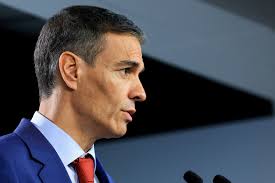
Spain’s Prime Minister Pedro Sanchez is seeing a political boost at home from his outspoken criticism of former U.S. President Donald Trump, a stance that is simultaneously sharpening diplomatic sensitivities between Madrid and Washington.
Sánchez has positioned himself as one of Europe’s most vocal critics of Trump’s trade rhetoric and foreign policy posture, particularly on issues relating to NATO burden sharing, climate commitments, and tariffs that have affected European exports. His firm tone has resonated with segments of the Spanish electorate who view strong alignment with European Union priorities as central to Spain’s global role. Recent polling suggests that his assertive foreign policy messaging has consolidated support among progressive voters and strengthened his image as a defender of European multilateralism.
Domestically, Sánchez’s approach reinforces his broader political narrative of strategic autonomy within the European framework. Spain has consistently backed deeper EU integration on defense coordination, energy policy, and industrial strategy, often aligning closely with Paris and Berlin. By drawing a contrast with Trump’s America First doctrine, Sánchez underscores Spain’s commitment to rules based international cooperation, climate diplomacy, and stable transatlantic engagement rooted in mutual respect.
However, the political dividends at home come with diplomatic complexities. The United States remains a critical security and economic partner for Spain, with extensive military cooperation through bases such as Rota and Morón, as well as strong bilateral trade and investment ties. Any sustained rhetorical friction risks complicating coordination on defense, migration, and economic policy, particularly if political dynamics in Washington shift again.
Spanish officials have emphasized that criticism of Trump’s positions does not equate to hostility toward the United States as a whole. Instead, Madrid maintains that its objective is to defend European interests while preserving the broader transatlantic alliance. Analysts note that Sánchez is walking a calibrated line leveraging anti Trump sentiment for domestic political capital without triggering substantive policy fallout.
The development illustrates a broader European recalibration toward Washington, where leaders are increasingly balancing domestic political considerations with strategic dependence on U.S. security guarantees. For Sánchez, the challenge now is sustaining domestic approval while ensuring that Spain’s relationship with the United States remains pragmatic, stable, and forward looking.











Leave a comment