


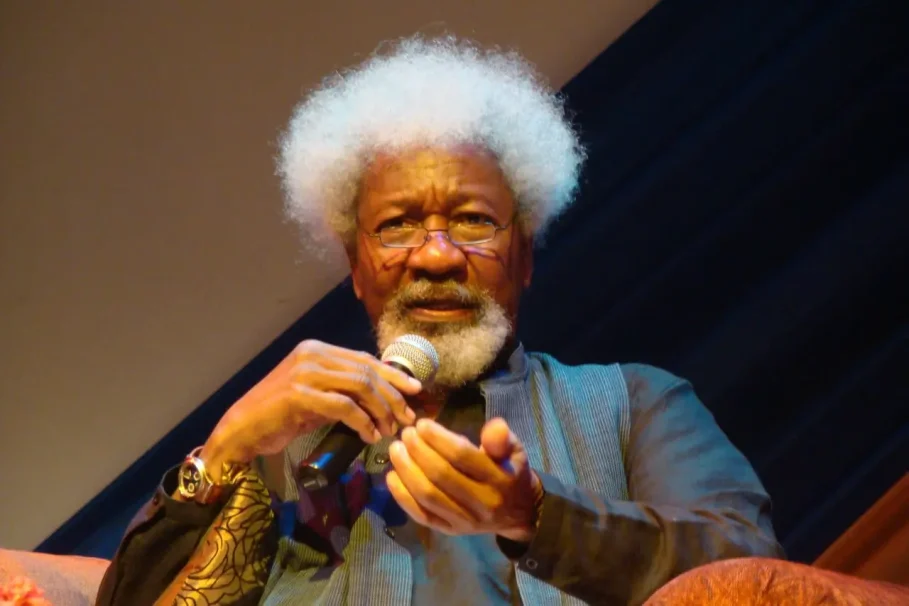
Nigerian Nobel laureate Wole Soyinka has revealed that the United States government has revoked his visa and placed a travel ban on him, bringing an abrupt end to decades of scholarly engagement and literary exchange with American institutions. The 91-year-old literary icon, who became Africa’s first Nobel Prize winner in Literature in 1986, made the disclosure during a news conference on Tuesday, describing the move as “a rather curious love letter from an embassy.”
According to Soyinka, the US Consulate in Nigeria invited him to bring in his passport in person so that his visa could be formally cancelled, citing newly discovered “information” that had prompted the action. However, no details were provided regarding what this information entailed. The Nobel laureate said he was informed that his visa was no longer valid and that he was effectively barred from entering the United States.
“I have no visa. I am banned,” Soyinka stated firmly, adding that he had received official communication from the US authorities confirming the decision. He advised organisations planning to host him in the United States to “not waste their time,” signalling that he would not be able to honour any invitations from American universities or institutions.
The US Embassy in Nigeria declined to comment, citing privacy laws that prevent it from discussing individual visa cases.
Soyinka, who has held numerous visiting professorships and teaching appointments at American universities over the past three decades, once had permanent residency in the US. However, he renounced his green card in 2016 in protest after Donald Trump’s election as president, symbolically cutting it in half and declaring his moral objection to what he described as “rising intolerance and xenophobia” in American politics.
At the press briefing, Soyinka reaffirmed that he no longer possesses the green card, saying with characteristic wit, “It fell between the fingers of a pair of scissors and got cut into a couple of pieces.”
The celebrated playwright and poet suggested that his visa revocation might be politically motivated, possibly tied to his outspoken criticism of former President Trump, whom he has repeatedly likened to dictatorial leaders. Recently, Soyinka compared Trump to Uganda’s infamous ruler Idi Amin, calling him “Idi Amin in white face.” He joked, “When I called Donald Trump Idi Amin, I thought I was paying him a compliment — he’s been behaving like a dictator.”
Idi Amin, who ruled Uganda between 1971 and 1979, was notorious for his brutal regime and human rights abuses that left hundreds of thousands dead. By drawing this comparison, Soyinka implied that Trump’s authoritarian tendencies echoed some of the hallmarks of dictatorial governance seen in Africa’s past.
When asked whether he would attempt to travel to the US again, Soyinka chuckled and replied, “How old am I?” — a remark that underscored both his resignation to the decision and his enduring sense of humour despite the controversy.
His ban comes at a time when the US State Department has tightened visa regulations for several African nations, including Nigeria. In July, Washington announced sweeping changes to non-immigrant visa policies, reducing visa validity for Nigerians, Cameroonians, Ethiopians, and Ghanaians to single-entry, three-month durations. This marked a significant rollback from the previous five-year, multiple-entry visas that many had enjoyed.
Analysts say Soyinka’s case reflects the growing tension between the US and African intellectuals who have been vocal critics of American foreign and domestic policy. Others see it as an unfortunate end to a long-standing cultural exchange between one of Africa’s most distinguished writers and the US academic community.
Despite the setback, Wole Soyinka remains unbowed. At 91, the globally revered writer continues to speak truth to power whether through his plays, essays, or public engagements, embodying the fearless intellectual spirit that earned him the Nobel Prize nearly four decades ago.









Leave a comment