


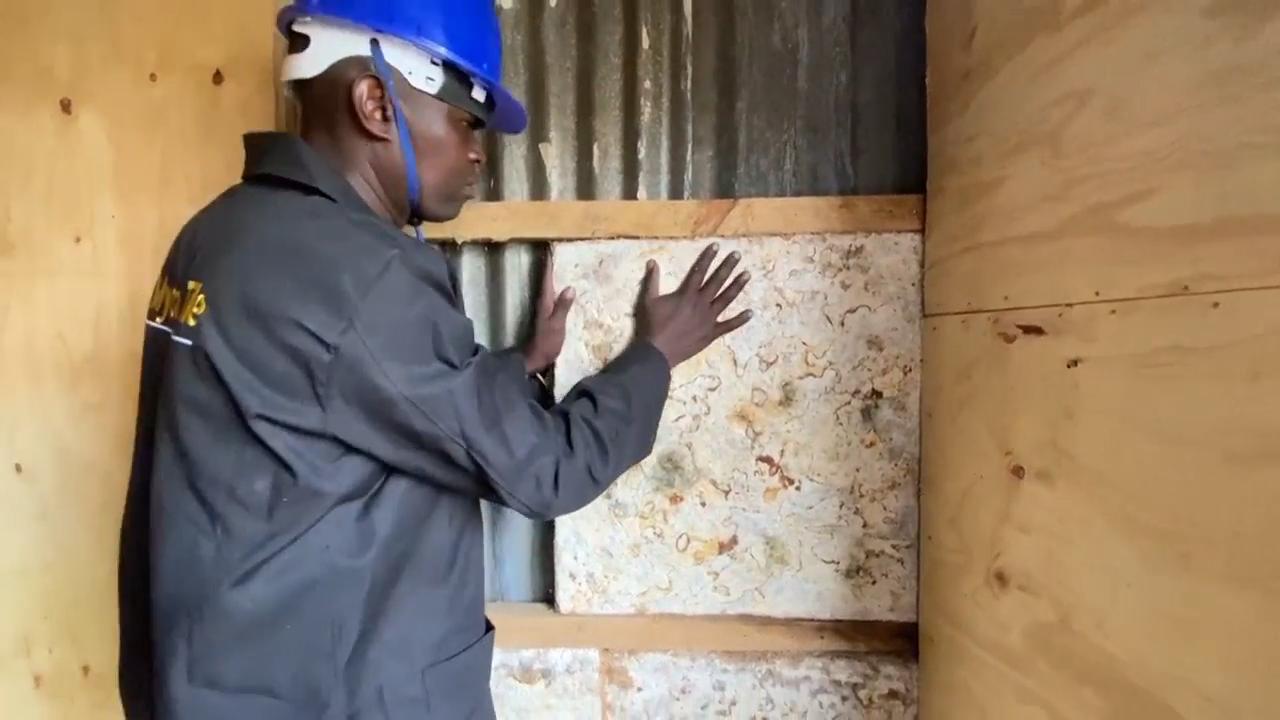
In the heart of Kenya’s capital, a groundbreaking innovation is reshaping the construction industry and offering hope to millions facing a housing crisis. A mushroom farm near Nairobi is producing fungi not for food, but as an eco-friendly building material that could redefine sustainable housing in Africa.
At the center of this innovation is MycoTile, a Kenyan company that uses mycelium the root structure of mushrooms to create building panels that are strong, lightweight, and affordable. The panels are produced by combining mycelium with natural fibers and other agents, resulting in versatile materials used for insulation, walls, and interior design. The company currently produces around 3,000 square meters of panels every month.
For Nairobi resident and street vendor Jedidah Murugi, who lives in a fungi-built home, the benefits are clear. “There is no huge difference in quality between houses made from brick and these boards,” she said. “The only difference is in the cost. My house is not cold at night and not hot during the day.”
With Nairobi’s housing deficit estimated at over 2 million units, MycoTile’s innovation couldn’t be timelier. Most Kenyans either rent or build homes slowly over many years, often living in incomplete structures to save on rent. Founder Mtamu Kililo believes his mushroom-based materials can bridge this gap by offering affordable, eco-conscious alternatives. “Introducing materials like ours taps into a huge market and helps provide affordable housing solutions,” Kililo explained.
A typical one-bedroom home in Nairobi can cost up to 150,000 Kenyan shillings (about $1,000) using traditional materials. MycoTile’s products, however, cut costs by about a third. Murugi’s 15-square-meter house, built with mushroom panels, cost just 26,880 shillings ($208).
Beyond affordability, the environmental benefits are equally striking. The Kenyan government, seeking to decarbonize the construction industry, has partnered with MycoTile through the Kenya Industrial Research and Development Institute, providing access to modern facilities. The company’s panels are biodegradable and reduce carbon emissions compared to conventional clay bricks or cement.
MycoTile also helps tackle agricultural waste, sourcing byproducts from western Kenya’s sugar factories and transforming 250 tons of waste annually into construction material. “We collect waste from sugar factories and use it to create the pasteurized agricultural base that binds with mycelium,” Kililo explained.
Kililo’s idea was inspired during a research fellowship in Rwanda, home to one of East Africa’s largest mushroom farms. “The used substrates looked like bricks, and I thought I could use them in building,” he recalled. What began as a kitchen experiment—baking fungi blocks in his oven—has now evolved into a commercial solution with immense potential.
Globally, mycelium-based innovations are gaining momentum. In Namibia, a nonprofit built the first mushroom house in 2024 using NASA-developed technology, while in the Netherlands, inventors are crafting biodegradable coffins from fungi and hemp fiber. Experts like sustainability architect Nickson Otieno say such innovations are vital in reducing emissions from construction, one of the world’s most polluting industries.
With its combination of low cost, eco-friendliness, and strength, MycoTile’s mushroom panels could be the game changer Kenya needs to tackle its housing crisis sustainably one fungi brick at a time.











Leave a comment