


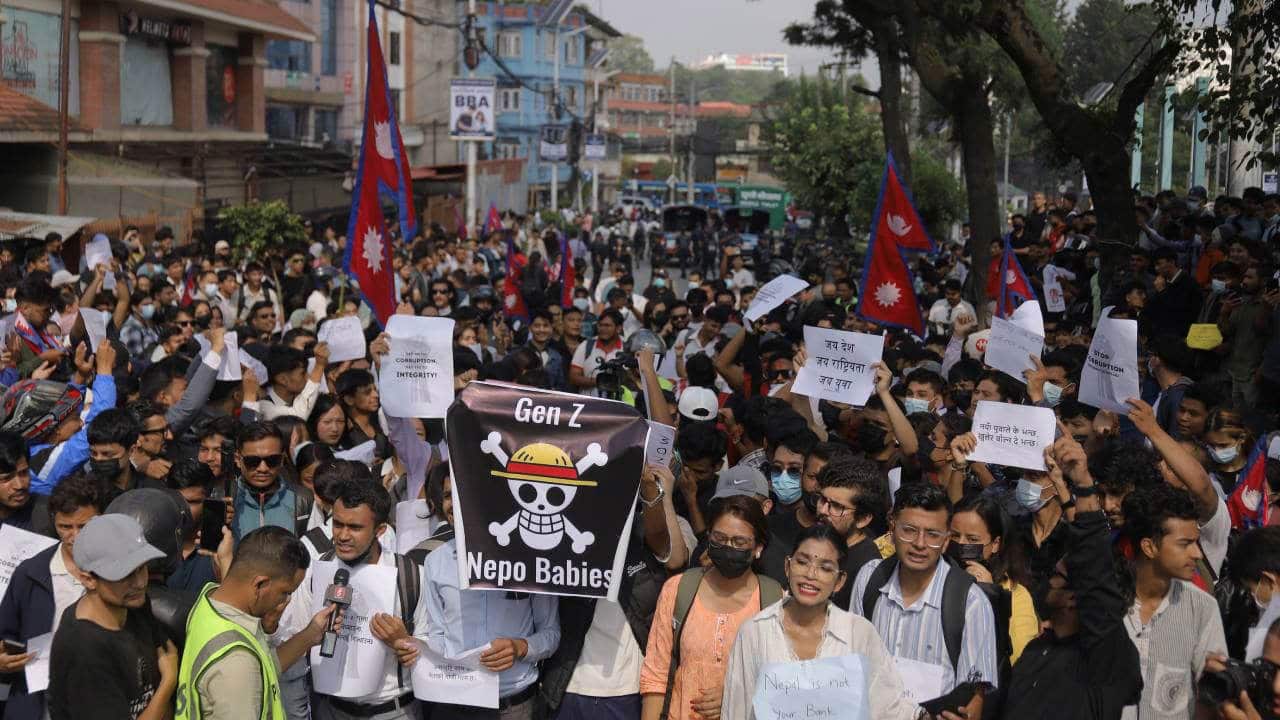
From Kathmandu to Lima, a wave of youth-led uprisings is sweeping across continents, uniting young people in a powerful global movement demanding accountability, justice, and a better future. From Asia to Africa to South America, Generation Z those born between 1997 and 2012, are leaving their screens for the streets, driven by anger, inequality, and a sense that their futures are being stolen by corrupt leaders and broken systems.
In Morocco, thousands of young protesters under the banner “GenZ 212” named after the country’s international dialing code have filled cities and towns for nights on end. The demonstrations, led largely by students and unemployed graduates, call for reforms in education, healthcare, and social justice. They accuse the government of ignoring public welfare while spending billions on preparations for the 2030 FIFA World Cup. The protests were sparked by the deaths of several pregnant women following routine C-sections in Agadir, which highlighted Morocco’s failing healthcare system. With youth unemployment at 36%, frustration has boiled over. The government’s heavy-handed response has left at least three people dead and hundreds injured, while riot police continue to patrol the streets. Prime Minister Aziz Akhannouch has offered dialogue, but protesters have escalated demands, calling for the government’s resignation.
The anger is not confined to North Africa. In Madagascar, thousands of young demonstrators have taken to the streets in outrage over water shortages, blackouts, and economic hardship. The protests quickly turned political, demanding the resignation of President Andry Rajoelina, who first came to power in a 2009 coup. At least 22 people have been killed, according to the United Nations, though the government disputes the figures. While Rajoelina dissolved his government this week, claiming he had “heard the call and felt the suffering,” the unrest shows no signs of abating.
In South America, Peru is also witnessing a surge of youth activism. Demonstrations that began in September over controversial pension reforms have morphed into a nationwide movement demanding an end to corruption, crime, and repression. President Dina Boluarte’s approval rating has plummeted to just 2.5%, reflecting the country’s widespread discontent. Protesters accuse the government of failing to address economic instability and of using violence against its own citizens dozens were killed in earlier demonstrations following Boluarte’s rise to power in 2022.
But perhaps nowhere has the impact of Gen Z activism been more dramatic than in Nepal. In September, protests against a government ban on social media quickly escalated into a full-blown uprising that toppled the prime minister. Within 48 hours, at least 22 people were killed and hundreds injured as young protesters burned government buildings in Kathmandu, demanding an end to corruption and stagnation. The fall of the Nepali government sent shockwaves across Asia and inspired similar youth-led movements in neighboring countries. The events mirror those in Bangladesh, where young people ousted longtime leader Sheikh Hasina in 2024, and in Sri Lanka, where the Rajapaksa dynasty collapsed in 2022 after mass demonstrations. Across South Asia, Southeast Asia, and Africa, a pattern has emerged: a digitally connected generation refusing to tolerate the failures of their leaders.
Experts say these movements are linked by shared frustration. Subir Sinha, director of the SOAS South Asian Institute, argues that the priorities of ruling elites have become completely detached from the realities of young people. “There is a catastrophic feeling around, with a sense of the end days of liberal democracy being felt country after country,” he said. Bart Cammaerts, a professor of politics and communication at the London School of Economics, describes Gen Z as a generation that feels “short-changed” — skeptical of traditional democratic systems yet deeply committed to the principles of justice and fairness.
This generation came of age in the aftermath of the 2008 financial crisis, has endured a global pandemic, and now faces a worsening climate crisis and economic uncertainty. In many countries, rising authoritarianism, corruption, and xenophobia have shut down the traditional pathways to prosperity. For millions, even migration — once a hope for escape — is no longer an option as borders tighten. “For young people, the idea of the future being cancelled feels very real,” Sinha explained. “That sense of hopelessness has become contagious.”
But if their grievances are global, so are their methods. Gen Z’s digital fluency has transformed protest movements. Using social media platforms such as Instagram, TikTok, Telegram, and Discord, they can organize protests in real time without formal leadership. In Morocco, for instance, the anonymous Discord server “GenZ 212” grew from just 3,000 to over 130,000 members within days — a digital uprising that rapidly spilled into the streets. In Madagascar, young organizers first mobilized through Facebook and TikTok before joining forces with civil society groups and trade unions. Their decentralized, online coordination makes these movements harder for governments to suppress, giving them a resilience unseen in earlier generations of activism.
Across continents, Gen Z is proving that digital natives can translate online outrage into real-world power. They are challenging entrenched elites, exposing corruption, and demanding accountability in ways that transcend geography and culture. And as each movement inspires another, a powerful new reality is emerging one where the world’s youngest citizens are no longer willing to wait for change. They are making it happen.












Leave a comment