


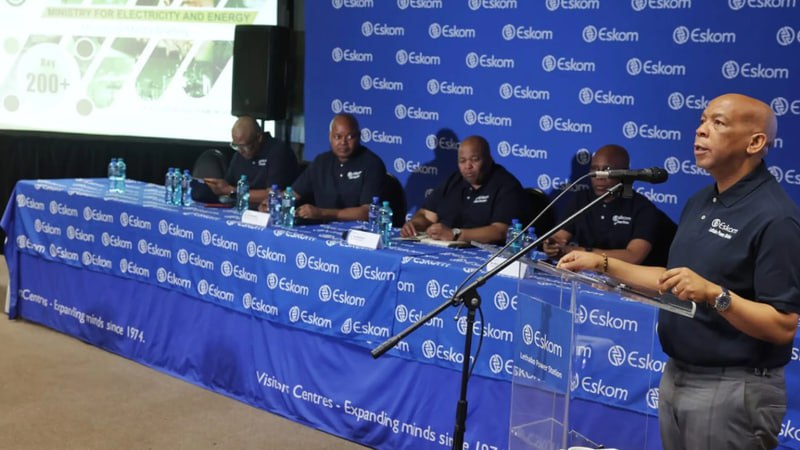
South Africa has celebrated over 200 days of uninterrupted power supply, marking a major turnaround in its battle against load shedding. The Minister of Electricity and Energy, Kgosientsho Ramokgopa, announced this achievement during a media briefing in Free State Province, emphasizing the government’s unwavering commitment to ending the long-standing energy crisis that has plagued the nation.
For years, load shedding has disrupted businesses, hindered economic growth, and affected the daily lives of millions of South Africans. This constant rolling blackout regime, caused by an overburdened and underperforming power grid, has been a source of national frustration. However, the government’s renewed focus on energy stability has begun to yield positive results, offering hope for a brighter future.
Ramokgopa highlighted the progress made by Eskom, South Africa’s embattled state-owned power utility, as a key factor behind this achievement. Eskom has successfully improved its energy availability factor (EAF), a critical metric measuring the percentage of time the power grid is operational. From a dismal 55% in March 2023, Eskom has boosted its EAF to over 66%, marking a significant leap forward. Ramokgopa stated that the utility is on track to achieve an EAF of 70% by 2025, promising even greater stability in the nation’s energy supply.
While optimistic, Ramokgopa acknowledged that there is still work to be done. “We are not out of the woods yet,” he said, addressing the media. “But we are making steady progress, and this achievement shows that we can overcome the challenges we face in our energy sector.” He added that efforts to improve Eskom’s performance, reduce maintenance backlogs, and enhance the reliability of power generation will continue as the country works to eliminate load shedding once and for all.
Eskom’s turnaround is a critical component of South Africa’s broader efforts to stabilize its economy. The power crisis has been a significant obstacle to growth, deterring investors and limiting the country’s productive capacity. However, with consistent power supply now being restored, the economic outlook is improving. In his weekly newsletter, President Cyril Ramaphosa echoed this sentiment, expressing optimism about the impact that energy stability will have on the nation’s GDP and investment climate.
“Achieving over 200 days without load shedding is a testament to the progress we are making,” Ramaphosa wrote. “It is clear that our efforts to restore Eskom to full functionality are paying off. This milestone will have a direct impact on our economy, with forecasts predicting up to 3% GDP growth in the next 18 to 24 months.”
The improvement in South Africa’s energy sector comes at a crucial time. The country has faced immense pressure to find solutions to its energy woes, which have long been cited as one of the biggest hurdles to economic recovery. Ramaphosa’s administration has prioritized energy reform as a key component of its broader economic revival plan, which includes attracting foreign investment, boosting industrial capacity, and creating jobs.
The consistent power supply is already making a difference on the ground. Businesses that had been forced to scale back operations or close entirely during periods of load shedding are now beginning to recover. With fewer interruptions, industries such as manufacturing, mining, and agriculture are seeing improved output, contributing to a more stable and vibrant economy.






Leave a comment