


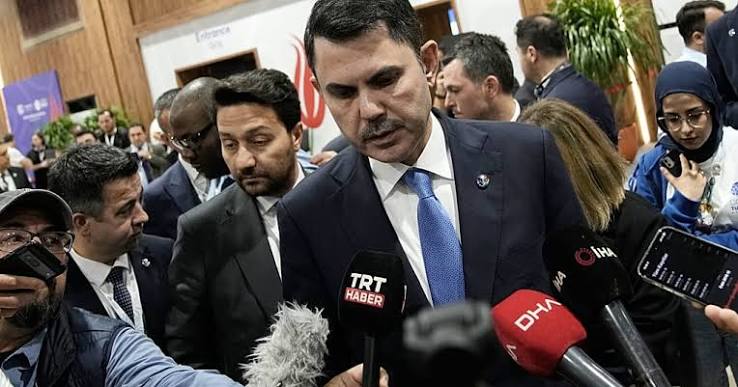
The 31st United Nations Climate Change Conference (COP31) in Antalya, Turkey, ended without an overarching agreement on Sunday after delegates failed to resolve deep divisions over fossil fuels and climate finance.
The two-week negotiations, which extended almost 48 hours beyond their scheduled conclusion, broke down after the European Union and several other countries rejected the final draft agreement for failing to explicitly address the transition away from coal, oil and natural gas.
The proposed deal, prepared under the joint leadership of Turkey and Australia, did not include a new commitment on fossil fuels, drawing objections from European countries and several climate-vulnerable nations.
They argued that omitting fossil fuels weakened the global response to climate change and favoured countries whose economies depend heavily on oil, gas and coal exports.
Russia and Saudi Arabia were among the countries that opposed including explicit references to fossil fuels in the agreement.
Ireland’s Climate Minister, Darragh O’Brien, speaking on behalf of the European Union, said the bloc would not endorse an agreement that failed to acknowledge fossil fuels as a major driver of climate change.
The disagreement prevented delegates from adopting the main conference decision, commonly known as the cover decision. COP agreements require consensus among participating parties, allowing objections from individual countries to block adoption.
COP31 President and Turkish Environment Minister Murat Kurum acknowledged the failure to reach consensus, saying the proposed decisions could not be adopted.
Australia’s Climate and Energy Minister, Chris Bowen, who led the negotiations alongside Turkey, described the divisions as difficult to bridge. He maintained that the commitment made at COP28 in Dubai to transition away from fossil fuels remained in force despite the latest setback.
Beyond fossil fuels, disagreements over financial support for developing countries also contributed to the breakdown.
Developing nations had sought clearer commitments on funding to help vulnerable communities adapt to rising temperatures, floods, droughts and other climate-related disasters.
The proposed agreement included a pledge to increase adaptation finance, but countries seeking stronger action argued that the draft lacked a clear baseline and sufficient guarantees.
There were also disagreements over proposed language supporting carbon capture and storage technologies. Some countries and environmental groups warned that greater reliance on these technologies could allow continued fossil fuel production instead of prioritising emissions reductions.
The failure to secure an overarching agreement marks a major setback for the international climate negotiation process. It is the first time since the 2009 Copenhagen climate summit that a UN climate conference has ended without adopting a main agreement.
However, the breakdown did not invalidate existing international climate commitments, including the 2015 Paris Agreement and the COP28 pledge to transition away from fossil fuels.
Despite the failure of the main negotiations, countries made progress on several separate initiatives.
Nearly 100 countries supported Turkey’s proposal to increase electricity’s share of global final energy consumption from about 21 per cent to 35 per cent by 2035.
The proposal seeks to accelerate the use of electricity in transport, industry and other sectors traditionally dependent on fossil fuels.
Other unresolved issues, including the development of plans for transitioning away from fossil fuels and financial assistance for vulnerable countries, are expected to return to negotiations at next year’s climate conference in Ethiopia.
UN Secretary-General António Guterres expressed deep disappointment over the outcome, saying the absence of consensus among governments did not change the scientific evidence on climate change.
The talks ended amid growing warnings that the world is on course to exceed the Paris Agreement’s goal of limiting global warming to 1.5 degrees Celsius above pre-industrial levels.
Scientists have warned that further delays in reducing greenhouse gas emissions will increase the risks of extreme heat, flooding, droughts and other climate-related disasters.









Leave a comment