


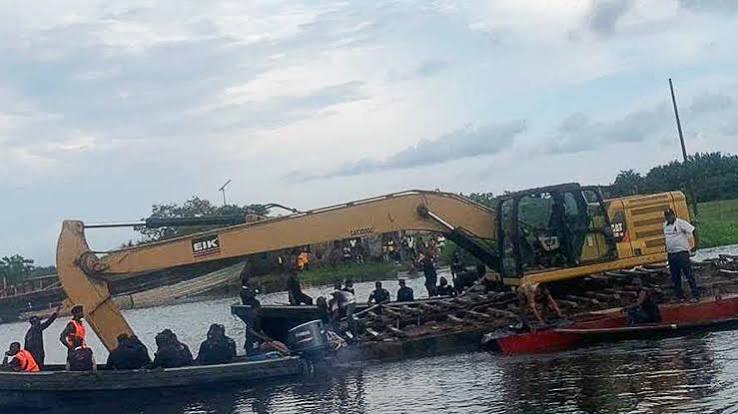
Search and recovery teams are facing major challenges in retrieving the remains of 25 people killed when a Nigerian Air Force aircraft crashed into a swamp in Igbokoda, Ondo State, with the wreckage submerged in difficult terrain.
The ATR 42 aircraft, with tail number NAF 931, crashed Monday while on a routine mission from Benin City to Lagos. The Nigerian Air Force later confirmed that 20 passengers and five crew members were aboard and that there were no survivors.
The crash site, about 500 metres east of the Nigerian Naval Forward Operating Base in Igbokoda, is surrounded by creeks, mangroves and thick vegetation. The aircraft is believed to have plunged deep into the swamp, making it difficult for conventional boats and vehicles to reach the wreckage.
Ondo State officials said divers had been working underwater and had recovered pieces of the aircraft, but the main wreckage remained difficult to reach. Authorities said the depth of the water and the force of the impact had pushed the aircraft deeper into the swamp.
Ondo State Commissioner for Police, Felix Ohagwu, said the difficult terrain had slowed the recovery operation, with rescuers requiring larger and more specialised equipment to remove the wreckage and victims.
The police commissioner said body parts and passengers’ clothing had been seen floating in the water, but the recovery of the remains was still ongoing. He said additional technical support was being awaited from agencies including the National Emergency Management Agency.
Two specialised swamp buggies, designed to operate in waterlogged and muddy terrain, were subsequently deployed by the Ondo State Government to assist the recovery effort. Officials said the machines would allow rescuers to reach areas that could not be accessed with conventional vehicles or boats.
The black boxes, which contain flight data and cockpit recordings that could help investigators determine what happened before the crash, had not been recovered as of Wednesday. Their retrieval is expected to be important to the investigation into the cause of the accident.
Local residents have also been assisting rescue teams, using boats to navigate the waterways around the crash site.
Omotayo Orimisan, a resident who participated in the search effort, said villagers witnessed the aircraft’s final moments before it crashed into the mangrove area.
“The plane flew from that side of town towards the other side of the creek, then its tail broke off with a loud noise,” Orimisan said, according to reports. He said the aircraft appeared to touch the water before lifting again and then diving into the forest across the creek.
Another resident, Felisia Michel, said rescue personnel had continued working for extended periods despite the difficult conditions.
The Nigerian Navy, Marine Police, local authorities and emergency responders have been involved in the operation, while military personnel have restricted access to the crash area as recovery efforts continue.
The crash has also prompted questions about the circumstances surrounding the aircraft’s final flight. Air traffic controllers lost contact with the aircraft at about 9:13 a.m. Monday after it departed Benin City for Lagos. The wreckage was subsequently located near the naval base in Igbokoda.
President Bola Tinubu declared three days of national mourning following the crash and ordered the Nigerian Air Force to conduct a thorough investigation into the circumstances that led to the accident. National flags were also ordered to be flown at half mast during the mourning period.
The Chief of the Air Staff, Air Marshal Sunday Kelvin Aneke, described the crash as a deeply painful loss for the Nigerian Air Force and the country. The Air Force has released the names of the 25 people aboard the aircraft and urged the public to avoid speculation while the investigation continues.
The immediate priority remains the recovery and identification of the victims’ remains and retrieval of the aircraft wreckage. Investigators will also need to recover the flight recorders and other evidence from the crash site before determining the cause of the accident.
The operation highlights the difficulties emergency responders can face when aviation accidents occur in Nigeria’s coastal and swampy regions, where access to crash sites can be severely constrained by waterways, vegetation and soft terrain.













Leave a comment