


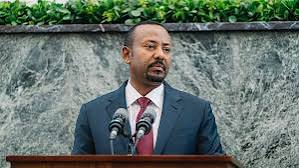
Prime Minister Abiy Ahmed has vowed to pursue access to the Red Sea for landlocked Ethiopia, saying the government will use peaceful engagement and mutual benefit as renewed fighting in the northern Tigray region raises fears of a wider conflict.
Abiy made the remarks Monday after being sworn in for another five year term. Addressing parliament, he said Ethiopia’s long term development depended on reliable maritime access and pledged to continue efforts to secure an outlet to the sea.
“Based on the principle of give and take, we will work diligently to ensure that Ethiopia has an outlet to the sea,” Abiy said, according to reports of his parliamentary address.
Ethiopia lost direct access to the Red Sea after Eritrea became independent in 1993. Addis Ababa has since relied heavily on ports in neighbouring Djibouti for its international trade, while Abiy’s government has increasingly argued that Ethiopia’s size, economic interests and geographic position give it a legitimate interest in securing maritime access.
The issue has become increasingly sensitive in relations with Eritrea, which borders Ethiopia and controls Red Sea ports including Assab. Eritrea has expressed concern that Ethiopia could seek access by force, while Abiy has repeatedly said his government intends to pursue the objective peacefully.
Abiy’s latest comments came as Ethiopian federal forces and Tigrayan fighters remained locked in renewed fighting, threatening to undermine the 2022 Pretoria peace agreement that ended a devastating two year war in Tigray.
Federal forces recently retook Mekelle, the Tigray regional capital, after Tigrayan forces withdrew from the city. However, fighting has continued elsewhere in the region, with airstrikes and artillery exchanges reported after the government regained control of Mekelle. Aid sources said strikes in parts of Tigray killed civilians, highlighting the continuing humanitarian risks.
The renewed fighting began in September after months of growing tensions between the federal government and the Tigray People’s Liberation Front. The conflict has revived concerns over a return to the large scale violence that devastated Tigray between 2020 and 2022.
The security situation has also contributed to worsening relations between Ethiopia and Eritrea. Addis Ababa has accused Eritrea of supporting forces opposed to the federal government, allegations Eritrea has rejected. Ethiopia and Eritrea have also severed diplomatic ties amid the escalating tensions.
Regional tensions intensified further after the presidents of Egypt, Eritrea, Somalia and Sudan met in Egypt on Sunday to discuss security and political developments in the Horn of Africa. The four countries called for regional disputes to be resolved peacefully and stressed the sovereignty of coastal states over the Red Sea.
Ethiopia responded by saying discussions on the Red Sea should take account of its geographic position and longstanding interests. The government has maintained that it is committed to dialogue and peaceful regional engagement while pursuing its national interests.
The dispute over maritime access is unfolding alongside Ethiopia’s longstanding disagreement with Egypt and Sudan over the Grand Ethiopian Renaissance Dam on the Blue Nile. The overlapping disputes have added to concerns that renewed fighting in Tigray could draw neighbouring countries into a broader regional confrontation.
The African Union and other international actors have called for restraint and dialogue as fighting continues. The immediate challenge for Ethiopia and its neighbours is to prevent the renewed conflict from undermining the fragile peace achieved in 2022 while addressing competing security, economic and maritime interests through diplomacy.









Leave a comment