


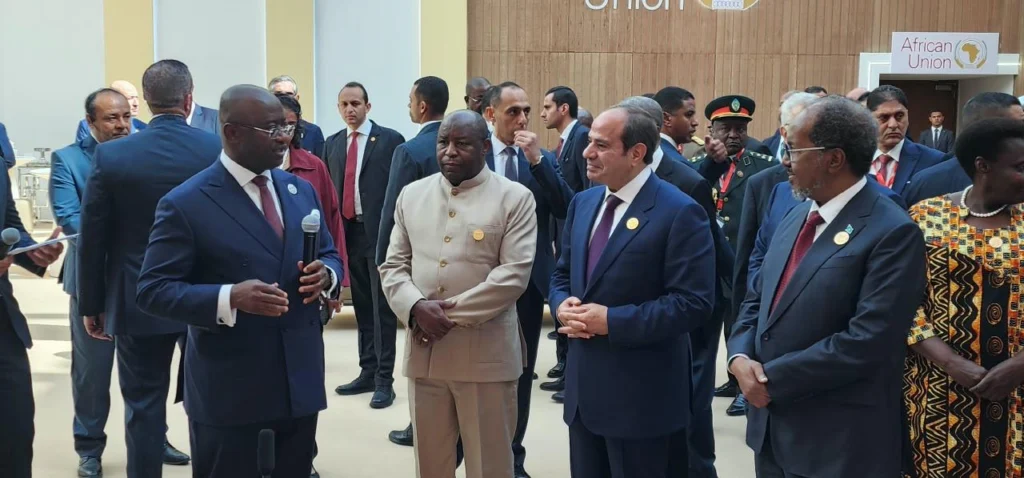
President and Chairman of the Board of Directors of the African Export Import Bank, Dr. George Elombi, has called on African governments to strengthen homegrown financial institutions and build a financial architecture capable of supporting the continent’s development with greater independence.
Elombi made the call at the opening of the Alamein Africa Forum 2026 in New Alamein, Egypt, where he urged African leaders to take greater responsibility for the institutions they have created and capitalised.
He said Africa needed financial institutions capable of mobilising the continent’s savings, financing intra African trade, supporting businesses and investing in infrastructure at the scale required to meet its development needs.
“We must build an African financial architecture in which African institutions can mobilise African savings, finance African trade, support African businesses and invest in African infrastructure at the scale our continent requires,” Elombi said.
Elombi said Africa’s financial independence did not mean withdrawing from global markets, but ensuring that the continent had stronger institutions and a greater role in shaping the international financial system.
“We are not seeking to replace the global system. Rather we are insisting on a place within it that reflects our weight, our capital, our markets and our ambitions,” he said.
He pointed to Afreximbank’s growth as evidence of what African countries could achieve through sustained investment in institutions owned and supported by the continent.
According to Elombi, the bank’s shareholders’ funds are approaching $9 billion, while its balance sheet has expanded roughly sixfold over the past decade. African shareholders paid almost $300 million in fresh equity into the bank in 2025, while $226 million had been contributed in cash in 2026, with another $300 million expected.
He argued that continued capital contributions from African governments were particularly important as traditional sources of development financing become less predictable and global financial conditions remain uncertain.
Elombi also criticised aspects of international credit rating methodologies, arguing that they can fail to adequately recognise the actual capital contributions and institutional structures of African multilateral financial institutions.
He said Afreximbank’s experience demonstrated the importance of having African institutions capable of responding when external financing becomes constrained. The bank has expanded its financing activities to support trade, infrastructure and businesses across the continent and has intervened during major economic disruptions, including the COVID 19 pandemic and the Russia Ukraine war.
The Afreximbank president said Africa’s financial architecture should be linked to broader efforts to industrialise, add value to raw materials and expand intra African trade.
He has previously argued that Africa cannot achieve meaningful economic sovereignty by continuing to export largely unprocessed commodities while importing finished products. Instead, he has advocated stronger manufacturing capacity, resource processing, regional trade and improved access to capital.
Elombi also stressed the importance of ensuring that African goods can move efficiently across the continent. He said financing, industrialisation, trade infrastructure and payment systems needed to work together to deepen the implementation of the African Continental Free Trade Area.
The call comes as African governments face pressure to mobilise more domestic resources for development amid changes in global trade, investment and development financing. Stronger African financial institutions could help increase the availability of capital for businesses, infrastructure and regional trade while reducing exposure to external financing disruptions.
For Africa, the push for greater financial independence is therefore closely linked to industrialisation, economic integration and the continent’s ability to retain more value from its natural resources and expanding consumer markets.








Leave a comment